Get Full Government Meeting Transcripts, Videos, & Alerts Forever!
Get email alerts on the Community Development topic
No spam. Unsubscribe anytime.
Council approves 2026 HUD action plan, funds park infrastructure and expands home‑repair guidelines
Summary
The Sacramento City Council approved the city’s 2026 HUD annual action plan and granted SHRA authority to proceed with a slate of CDBG, HOME, ESG and HOPWA activities, including park restroom installations and expanded home‑repair grants.
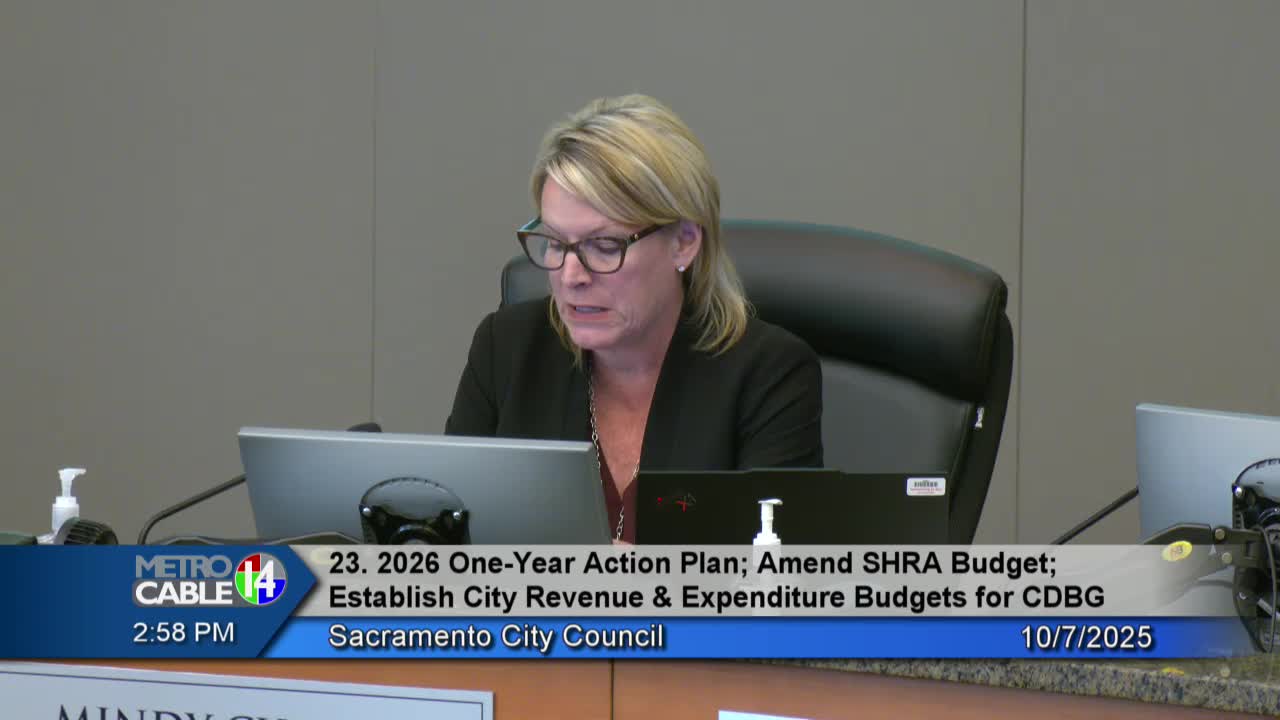
The Sacramento City Council on Tuesday approved the city’s 2026 annual action plan for HUD formula grants — including Community Development Block Grant (CDBG), HOME Investment Partnerships (HOME), Emergency Solutions Grant (ESG) and Housing Opportunities for Persons with AIDS (HOPWA) — and amendments to prior year action plans and SHRA program guidelines.
Stephanie Green, Federal Programs Manager at the Sacramento Housing and Redevelopment Agency, told the council the plan identifies funding sources and activities and asked for approval of the final list of projects recommended for 2026. "Today, we're asking you to approve the 2026 annual action plan for HUD formula program grants administered by SHRA," she said.
Allocations and projects: staff presented estimated entitlements (including reprogrammed funds and program income) totaling roughly $11.2 million for the city across HUD formula programs. Recommended CDBG infrastructure projects for 2026 include new restroom installations at Robla Community Park and Earl Warren Park and ADA walkway installation at Mangan Park (a reprogramming from an earlier Argonaut Park project). CDBG is also proposed to fund Meals on Wheels, home repair programs, fair‑housing activities (renters hotline and legal services), and public services at the Capitol Park Hotel. ESG funds are proposed for rapid re‑housing; HOME funds target multifamily rehab and new construction; HOPWA funds will support housing assistance, operations and case management.
SHRA home‑repair program changes: SHRA proposed and the council approved amendments to the Home Repair Program Guidelines to increase the maximum grant per property to $10,000, expand eligible accessibility improvements, and allow application windows to be extended or made year‑round as funding permits. Staff said the changes respond to rising costs and will make the program more responsive to vulnerable homeowners. SHRA also noted a related city pilot (Justice for Neighbors Emergency Home Repair Pilot) was one‑time funded and nearly depleted; SHRA staff agreed to accept referrals from city code enforcement and to explore funding opportunities.
Council direction and concerns: several council members welcomed projects that serve North Sacramento neighborhoods and emphasized coordination between SHRA and city staff. Councilmember Guerra asked SHRA to work with city code enforcement to preserve and continue the city's home repair program that uses different administrative arrangements (e.g., Habitat for Humanity) and raised a concern about the proportion of administrative costs in the county‑administered component of repairs. The council supported creating a staff‑level HUD entitlement/implementation committee to improve early collaboration between city departments and SHRA.
Action: the council moved and seconded a motion to approve the 2026 action plan and related SHRA budget and guideline amendments; the motion passed 8–0.
Follow up: SHRA will continue administering the HUD formula grants and implement the amended home repair guidelines; the council directed SHRA to coordinate with city staff and to report back on program execution and county/city administrative costs as appropriate.