Get Full Government Meeting Transcripts, Videos, & Alerts Forever!
Get email alerts on the Education Legislative Priorities topic
No spam. Unsubscribe anytime.
Broward school board tightens legislative platform after heated debate on cameras in ESE classrooms
Summary
At a special meeting the School Board of Broward County approved changes to its state and federal legislative priorities, including new language on audio-visual recording in self-contained ESE classrooms, an added push for industry certification funding, and new references to student well-being and homeschooling accountability.
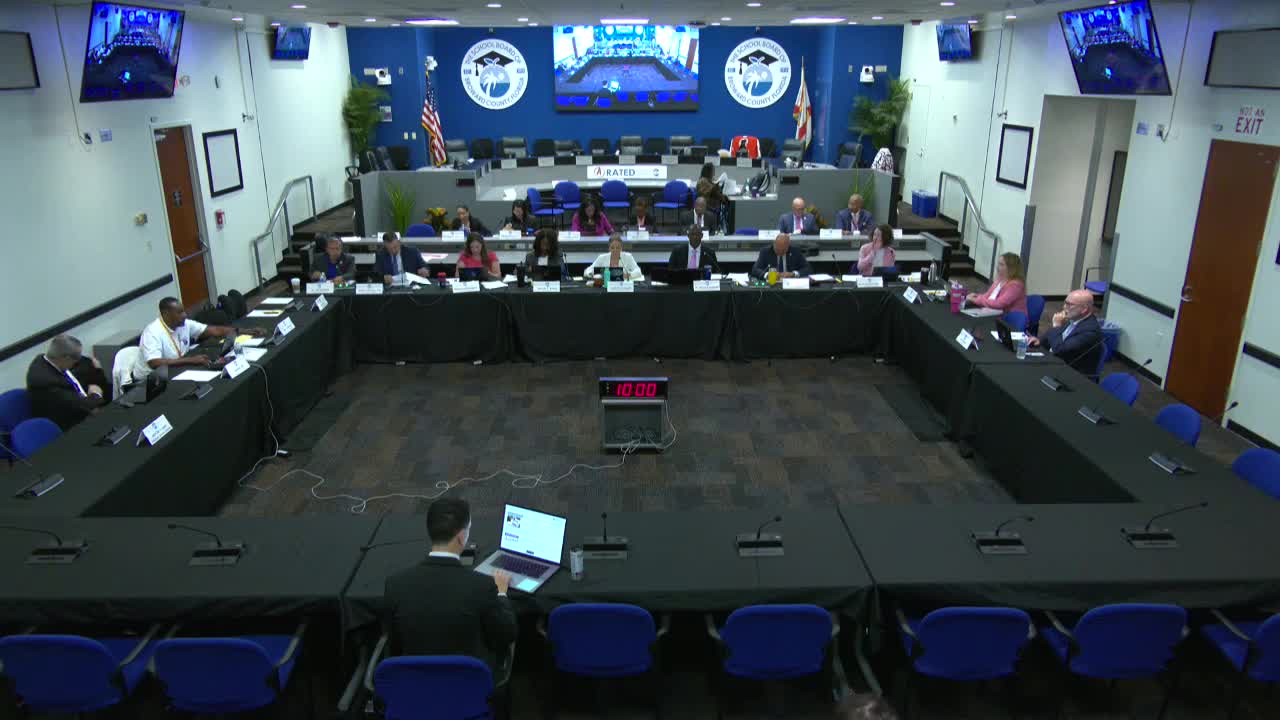
The School Board of Broward County, Florida on Oct. not specified approved a revised state and federal legislative priorities platform after extended public comment and board debate that focused on the use of audio-visual recording in self-contained exceptional student education (ESE) classrooms and new requests for industry certification funding.
The board voted to add a bullet asking state lawmakers to expand industry certification opportunities, including leadership and soft-skill credentials, and amended the platform’s camera language so it would support legislation “that provides clear guidance on the use of audio-visual recording in self-contained ESE classrooms” while allowing for annual parent notification rather than a parental opt‑in requirement described in earlier pilot programs.
The changes stemmed from public comment by Jacqui Luscombe, identified in the record as chair of the district’s ESE advisory committee and a parent, who said the draft platform wording did not reflect the narrower direction some board members had discussed at a prior workshop and urged language that would allow the district to implement cameras without requiring a signed parental opt‑in. Board members and staff debated three options raised during the meeting: (1) retain an opt‑in requirement, (2) require opt‑out, or (3) pursue a statutory “carve‑out” (a new subsection in the Parental Bill of Rights statute) to allow ESE classroom recording to operate like other campus surveillance. Board members also discussed whether the legislative platform should be broad to give lobbyists flexibility or specific about which statutory change to seek.
John Sullivan, identified in the meeting as chief of staff for communications, told the board staff could mirror language from the prior pilot program. Simone Hollingsworth, a district staff member, confirmed that the earlier pilot had operated with parent notification tied to an initial request (described in the meeting as an opt‑in process for installation), and counsel and staff repeatedly clarified operational differences between the pilot and the Parental Bill of Rights (statutory references discussed during the meeting included 1003.574 and 1014.041 as cited aloud by speakers).
After further motions and substitute language, the board approved language that would allow district advocates to seek guidance from the state and to pursue “annual parent notification” for cameras in self‑contained ESE classrooms so that the district could feasibly implement cameras across such classrooms while still informing parents and staff. Board members emphasized the motion gives lobbyists authority to explore options in Tallahassee rather than prescribe a single statutory solution from the dais.
Separately, the board unanimously approved adding a new legislative priority under academic excellence to “support legislation to expand industry certification opportunities for students, including but not limited to leadership and soft‑skill coursework.” That addition followed remarks from the district’s student advisor (identified in the record as Landon, student advisor) describing a state‑level initiative led by the Florida Association of Student Councils and sponsored by the Florida Association of School Administrators to broaden which credentials qualify for CAPE funding.
The board also adopted several other platform edits by unanimous vote: adding “accountability for all entities receiving public dollars” to a funding bullet, replacing the heading word “wellness” with “mental health,” reordering two priority bullets to emphasize funding requests, and inserting language to strengthen protections for “student well‑being” and to reference homeschool accountability in a funding context.
Board members and staff repeatedly cautioned the meeting and the platform are directives for the board’s lobbyists and superintendent lobby team, not the drafting of statutes; members said the intent was to give the district authority to advocate broadly in Tallahassee and to “feel out” what changes might be possible. Where board members wanted a narrower direction — for example, an explicit statutory carve‑out to the Parental Bill of Rights allowing surveillance in ESE classrooms without opt‑in or notification — they noted a separate motion would be needed to direct staff to pursue that specific text.
The board’s final vote approved Item 1 — the state and federal legislative priorities — as amended.
The board’s discussion included extended public comment both for and against altering parental consent requirements and several board members said they sought more time if the board wanted to adopt specific statutory language rather than broad lobbying direction. Staff said they would take the board’s amended platform as instruction for the district’s legislative advocates and for future discussions with state education officials.
The board approved Item 1 as amended on a voice vote.