Get Full Government Meeting Transcripts, Videos, & Alerts Forever!
Get email alerts on the Tax Levy Budget topic
No spam. Unsubscribe anytime.
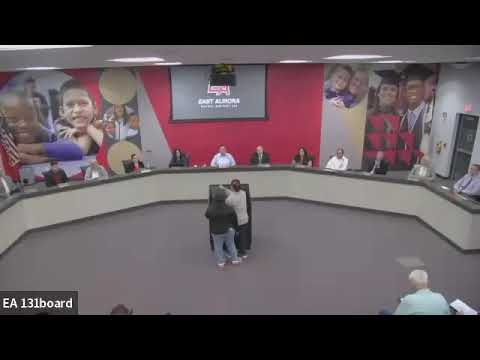
East Aurora board leans to mid‑range tax‑levy abatement; multiple consent agenda items approved
Summary
Board heard a presentation on the 2025 estimated tax levy and directed staff to pursue a mid‑range abatement; the meeting included unanimous roll‑call approvals for routine personnel and policy items, and a grant‑funded expansion of a prevention program.
At its Oct. 6, 2025 meeting, the East Aurora School District 131 Board of Education reviewed the district’s 2025 tax‑levy timeline and alternatives and directed staff to recommend a mid‑range abatement approach to soften the tax impact.
Finance staff and consultant Liz Hennessy of Raymond James presented data showing the county’s estimated equalized assessed valuation (EAV) rising about 11.5% for 2025, and three abatement options for the district’s bond and interest levy: no abatement, a $350,000 abatement and a $718,000 abatement (the latter approximating last year’s abatement). The district’s presenters said the full no‑abatement option would produce a gross levy change of roughly +4.38%, the $350,000 abatement would result in an estimated +3.57% change, and the $718,000 abatement would yield roughly +2.73%.
Liz Hennessy noted that abatements reduce the tax burden on current property owners by shifting evidence‑based funding into the bond fund to pay debt service and cautioned that abating reduces funds available for general operations. Hennessy said the county clerk’s EAV projection (11.5%) and a modest median home‑sale appreciation (about 1.9% districtwide) together could lower individual homeowner bills even when the levy is increased.
After discussion, the board reached consensus to pursue the mid‑range option (abatement of $350,000) as the recommended path for the formal levy adoption process; the board will vote on the final levy at a later meeting. “If we go from a large abatement the year prior to almost no abatement, it’s almost like a big slingshot up in the tax rate,” Superintendent Dr. Michael Engel said in urging a measured approach.
The meeting also included a number of consent and finance motions that passed unanimously by roll call. Items approved included routine personnel additions and program actions: the fiscal‑year 2026 bank signature cards; the resolution estimating the 2025 tax levy (the estimate needed now for publication and later formal adoption); one full‑time equivalent 1:1 special‑education teacher assistant at Oak Park Elementary; one FTE 1:1 special‑education teacher assistant at East Aurora High School; a band overload at Simmons Middle School; approval of an administrative procedures project with the Illinois Association of School Boards (IASB); revisions to IASB PRESS board policies A–M; and a grant‑funded expansion of the Aaron’s Law prevention program with Mutual Ground for early‑learning through fifth grade.
Votes at a glance - Fiscal‑year 2026 bank signature cards — motion approved (roll‑call, unanimous). - Resolution estimating the 2025 tax levy — motion approved (roll‑call, unanimous). The board gave direction to pursue a $350,000 abatement as the recommended option at the formal adoption vote. - 1.0 FTE 1‑to‑1 special education teacher assistant, Oak Park Elementary — approved (roll‑call, unanimous). - 1.0 FTE 1‑to‑1 special education teacher assistant, East Aurora High School — approved (roll‑call, unanimous). - Band overload, Simmons Middle School — approved (roll‑call, unanimous). - Administrative procedures project with IASB — approved (roll‑call, unanimous). - Revisions to IASB PRESS policies (A–M) — approved (roll‑call, unanimous). - Expansion with Mutual Ground (Aaron’s Law), early learning–5th grade — approved (roll‑call, unanimous; grant‑funded, $21,965 from IDEA funds).
Board members said the mid‑range abatement balances taxpayers’ interests against budget‑year uncertainty, including enrollment declines and upcoming labor negotiations. A formal tax‑levy adoption resolution will return for board action on Nov. 3, when the board is scheduled to vote to adopt the 2025 tax levy and finalize any abatement.