Get Full Government Meeting Transcripts, Videos, & Alerts Forever!
Get email alerts on the County Budget 2026 topic
No spam. Unsubscribe anytime.
Marathon County presents a status-quo 2026 budget with targeted capital cuts, new airport guarantee and homelessness funding
Summary
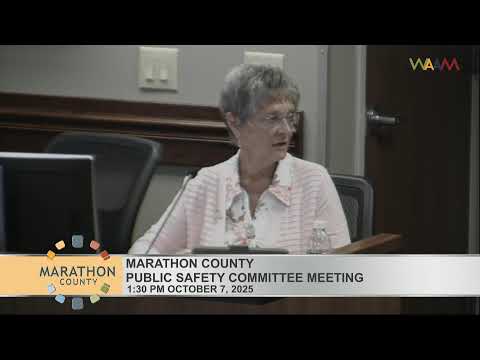
At the Oct. 7 Marathon County Public Safety Committee meeting, county administration described a 2026 budget that largely holds the line while adding a minimum revenue guarantee for the airport, funding for homelessness efforts and holding approximately 15 FTEs vacant to balance costs.
MARATHON COUNTY, Wis. — Marathon County administration told the Public Safety Committee on Oct. 7 that the proposed 2026 budget is largely status quo but includes targeted new spending for a minimum revenue guarantee for the Central Wisconsin Airport and enhanced funding to address homelessness.
The county administrator called the proposal "really a status quo budget" and said it follows budget assumptions previously set by the county board. The presentation emphasized conservative revenue estimates, holding vacant positions to reduce levy pressure and shifting some costs or revenues where possible.
Key figures outlined by administration include a net new construction rate of 1.61%, which the presenter said produces roughly $837,000 in additional tax levy revenue and about $1 million when combined with a personal property tax adjustment. The presenter said departments identified the equivalent of about 15 full-time positions to hold open in 2026 to help balance the budget.
The sheriff's office is the largest department affected: the budget shows about $1,230,000 of net change between 2025 and 2026 for the sheriff's office, a figure the presenter said reflects staffing and contract cost changes. Administration also noted a roughly $91,250 transfer from the Department of Social Services to reserve juvenile detention capacity for Marathon County youth; that transfer accounts for part of the sheriff's net increase.
Clerk of courts offices received a modest boost in state support, the presenter said — about $10,000 per branch, totaling just over $60,000 across six branches — which allowed the clerk of courts' levy request to fall slightly. The district attorney's office did not receive comparable new state funding and is up about $62,000 in the proposed county budget.
The presentation highlighted the county's ‘‘prelim testifier’’ program for court operations, in which the county employs a part-time reader to reduce the need for law-enforcement officers from multiple jurisdictions to appear for preliminary hearings. Administration said the county bills municipalities for usage of that position.
The medical examiner's office, which the county recently transitioned to a physician-led forensic science center, shows a small tax-levy increase (just under $40,000) while its overall operating budget rises to cover new staff, including two forensic pathologists and an autopsy support position. Administration said the office is budgeting increased revenue from autopsies for other counties and will report operations to the committee regularly.
On capital, administration said it trimmed the capital improvement program from more than $10 million in requests to roughly $5 million to fund only the most critical projects. The presentation said critical IT infrastructure and IT security were prioritized, with transportation projects selected to protect the county’s eligibility and future levels of state general transportation aid. The county designated $30 million in highway reserves toward a proposed highway shop relocation; administration discussed a hypothetical $50 million project with a $20 million financing gap if the board opted not to borrow for that work.
The presenter outlined a financing option that would use existing debt-service capacity — including payments currently made by North Central Health Care — and other reserves to avoid issuing new bonds. As an example, administration said borrowing $20 million over 20 years at 3% would produce about $6.89 million in interest, at 4% about $9.4 million, and at 5% about $12.1 million. The presenter said staff and financial advisers would refine assumptions if the board pursues that path.
Administration also discussed use of American Rescue Plan Act (ARPA) funds. The presenter said the county used ARPA primarily for one-time capital and infrastructure projects (courtroom AV upgrades, radio upgrades, the forensic science center) and does not generally use ARPA to fund recurring positions; the county expects a modest amount of unspent ARPA (about $500,000) to remain available for critical capital needs.
Committee supervisors asked detailed questions about fund balances, the availability of working capital after the county's recent loan transactions, how ARPA had been used, and whether fee increases affect departmental revenue. Administration said the 2024 audit and prior use of reserves left little unallocated fund balance to roll into capital, which is why the capital program was pared back.
No formal committee vote on the 2026 budget occurred at the Public Safety Committee; the presentation was for review and committees and the full county board will continue to consider changes through the November budget hearings and adoption.