Get Full Government Meeting Transcripts, Videos, & Alerts Forever!
Get email alerts on the Interscholastic Athletics topic
No spam. Unsubscribe anytime.
Policy committee reviews PIAA-driven changes to athletics policy, including eligibility, insurance and name/image/likeness rules
Summary
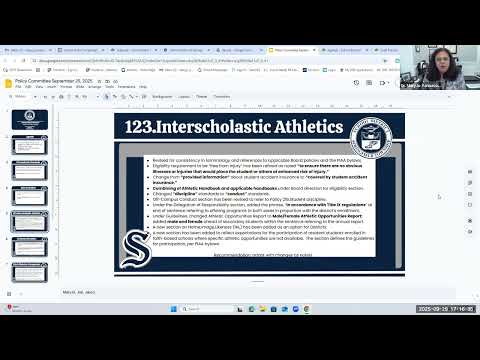
Springfield Township SD’s policy committee reviewed a broad set of changes to the interscholastic athletics policy to align with PIAA bylaw updates and court orders on eligibility of students from faith-based schools; the draft adds explicit accident-insurance guidance, a name-image-likeness notification requirement and Title IX-related reporting.
The policy committee on Sept. 29 reviewed substantial revisions to the district’s interscholastic athletics policy to align with recent PIAA (Pennsylvania Interscholastic Athletic Association) bylaw changes, court guidance and federal Title IX expectations.
Mr. Ferraro, the district’s high school athletic director, joined Dr. Johnson to explain the changes. The proposed updates broaden the eligibility-language standard from a requirement that a student be "free from injury" to a physician-verified determination that a student has no obvious illness or injury that would increase risk. The policy also clarifies that families without health insurance can be offered the district’s accident-insurance option; Ferraro said some plans have annual premiums "as low as $30," and the district works with individual families to avoid excluding athletes for financial hardship.
The draft consolidates athletic handbook provisions with the student code of conduct, aligns off-campus conduct enforcement with Policy 218 (student discipline) and includes a new reference to Title IX compliance for offering athletic programs in proportion to district enrollment. Dr. Johnson noted the district’s most recent male/female participation figures were roughly in parity (about 48% female enrollment and nearly 50% female athlete participation) for the high school.
The draft adds a new name-image-likeness (NIL) section requiring student-athletes and families to notify the district if a student has entered into promotional or sponsorship arrangements (examples cited included a youth bowler who filmed commercials for a local business). The policy would require notification, and the PIAA has rules on allowable earnings and timelines for notification.
Committee members asked about several operational points: whether filming on school property would be restricted (the policy does not currently prohibit filming; administrators said they could add athletic-handbook language requiring athletic director approval), liability and transportation for non-enrolled residents participating under the new faith-based eligibility guidance, and whether the PIAA changes could expand into non-athletic extracurriculars. Dr. Johnson said the policy is written to require residency verification, a physical, and the same eligibility standards as other athletes for faith-based or homeschooled students who seek to participate when their school does not offer a program.
The committee noted a recent court decision and PIAA guidance that students who are residents of a district but attend faith-based schools may be eligible to participate in public-school athletics when their private school lacks a program; PIAA and the courts clarified these students do not count toward the public school’s enrollment for classification purposes. Administrators said the district expects the change to begin with the winter athletic season and planned two readings (first reading in October, second in November) to meet scheduling deadlines.
Committee members expressed support to proceed with the draft, with follow-up items assigned to the athletic director to clarify handbook language and operational details.