Get Full Government Meeting Transcripts, Videos, & Alerts Forever!
Get email alerts on the Public Officials Compensation topic
No spam. Unsubscribe anytime.
Board introduces ordinance to raise supervisors' salaries to 75% of Superior Court judge pay over three years
Summary
The Board of Supervisors voted to introduce an ordinance to change supervisor compensation from 60% to 75% of a California superior court judge's salary phased in over three years; the ordinance also removes the annual CPI adjustment and ties future changes to state-set judge salaries.
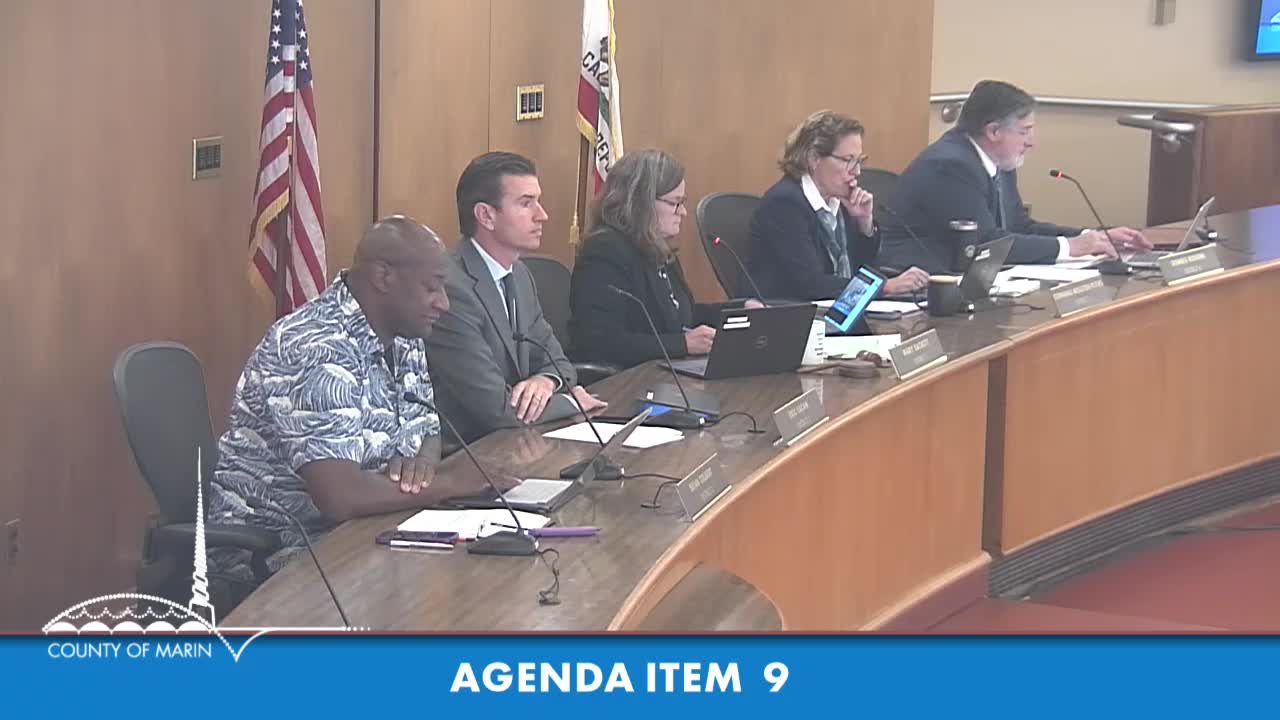
The Marin County Board of Supervisors on Sept. 30 voted to introduce an ordinance amending county code to revise the board's compensation structure over a three-year period, increasing supervisor pay from 60% to 75% of the annual salary for a California superior court judge and eliminating the current San Francisco Bay Area CPI-based cost-of-living adjustment.
Christina Kramer, the county's director of human resources, summarized the proposal and rationale. The ordinance would phase increases in 5% increments: increase to 65% in the first step (first pay period 2026) and then successive 5% annual increases to reach 75% by 2028. Kramer said the change would keep supervisor pay aligned with Bay Area peers (Sonoma County is at 75%) and reduce barriers for candidates who otherwise could not serve.
Kramer also described no change to fringe benefits and confirmed salary adjustments would follow the salary changes for superior court judges as set by the state Department of Finance. Kramer said current code had last changed in 2003 and that the county's duties and time commitment for supervisors have expanded.
Board discussion and action: Supervisors discussed optics and workforce equity with several noting the difficulty of setting elected officials' pay. Supervisor Rodoni said the increase would help open opportunities for more diverse candidates; Supervisor Milton Peters and others supported the change. The board approved introduction of the ordinance and will consider final adoption at a subsequent meeting.
Public comment: A county executive staff member and others urged awareness of county workforce reactions and recommended attention to employee pay and equity considerations; no members of the public opposed the ordinance on record at the meeting.
Next steps: The board introduced the ordinance; if adopted at the following board meeting it would take effect for the first pay period in 2026 and complete the phase-in by 2028.