Get Full Government Meeting Transcripts, Videos, & Alerts Forever!
Get email alerts on the Administrative Law Education Funding topic
No spam. Unsubscribe anytime.
Michigan high court hears dispute over whether school aid challenges must proceed through state education agency
Summary
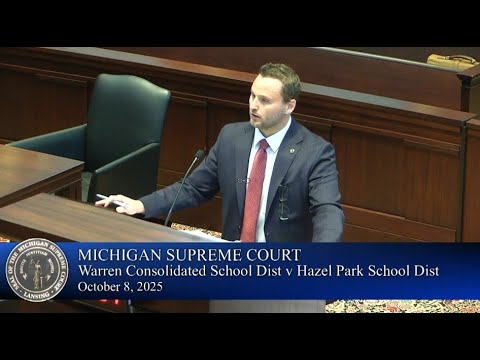
At oral argument, lawyers for Warren Consolidated School District and the School District of Hazel Park disputed whether Warren Consolidated could sue Hazel Park directly or first must exhaust administrative review with the Michigan Department of Education; the court submitted the case for decision.
The Michigan Supreme Court heard oral argument in Warren Consolidated School District v. School District of Hazel Park on whether Warren Consolidated could bring an original declaratory-action claim against Hazel Park or instead must pursue review through the Michigan Department of Education (MDE) under the Administrative Procedure Act. Appellant counsel Nathan Curesack told the court Warren Consolidated seeks primarily declaratory relief to stop what it calls a long-running practice of Hazel Park counting students that Warren Consolidated says it educated, and that the district lost more than $10,000,000 in state funding since February 2008 because of those counts.
Why the question matters: the dispute turns on competing readings of two judicial-review provisions of the Michigan Administrative Procedure Act (as discussed at argument, commonly referenced as section 263 and section 264) and on whether the MDE’s membership-audit process and the Michigan Pupil Auditing Manual operate as agency rules that must be appealed administratively before filing an original action in circuit court. That procedural choice determines whether school districts may press claims for reimbursement or whether the state agency must remain the central forum for membership-count disputes.
Curesack said Warren Consolidated followed the path the circuit court required: it requested declaratory rulings from MDE officials and from the state superintendent and received declinations stating the department’s processes do not permit one district to challenge another district’s membership counts. Curesack told the justices those declinations satisfied the condition precedent in the statute and allowed Warren Consolidated to file an original action in circuit court; he argued the subsequent dismissals under what the parties called “section 63” were improper because they rest on a different statutory standard that applies only when there is an “actual state of facts,” which Curesack said does not exist where the parties dispute underlying membership facts and the agency provides no hearing.
Thomas Landau, counsel for Hazel Park, argued the opposite: MDE has authority and responsibility for student membership counts, and Warren Consolidated’s failure historically to name the MDE as a party or to pursue available administrative review remedies is fatal to Warren Consolidated’s claims. Landau said allowing suit directly against Hazel Park would let districts “stand in the shoes” of the MDE, risk inconsistent outcomes across trial courts, and undermine uniform administration of school aid. He told the court Warren Consolidated had multiple opportunities to add the MDE to its pleadings and pursue review under the APA and that, on the merits, Warren Consolidated’s claims likely lack merit.
Both sides cited prior decisions and agency practice. Counsel for Warren Consolidated pointed to (as discussed at argument) the Human Rights Party and Huron Valley precedents and to the way the pupil-auditing manual has been amended over time; counsel for Hazel Park emphasized the policy reasons for vesting membership-count disputes with MDE and noted the department’s oversight role in approving counts and disbursing funds.
The justices queried both sides on procedural sequence: whether the auditing manual constitutes a “rule” under the APA, whether a declaratory-ruling declination operates as the kind of agency action that permits an original action in circuit court, and whether Warren Consolidated should have named the MDE earlier. Curesack said Warren Consolidated sought declaratory rulings and was twice declined; he acknowledged that, if orders are reversed and the matter remanded, naming the MDE would be a “procedural” step the district would take. Landau responded that Warren Consolidated repeatedly had chances to add MDE and instead pursued monetary claims against Hazel Park in circuit court.
The court announced the case was submitted for decision. The clerk told counsel the opinion will be released tomorrow morning. The justices did not issue any ruling at the argument.
Ending note: the dispute centers on how courts should treat the interplay of the APA’s judicial-review provisions and the MDE’s membership-audit procedures when competing school districts contest which district is entitled to state school-aid funding for particular students.