Get Full Government Meeting Transcripts, Videos, & Alerts Forever!
Get email alerts on the Urban Forest And Parks Paving topic
No spam. Unsubscribe anytime.
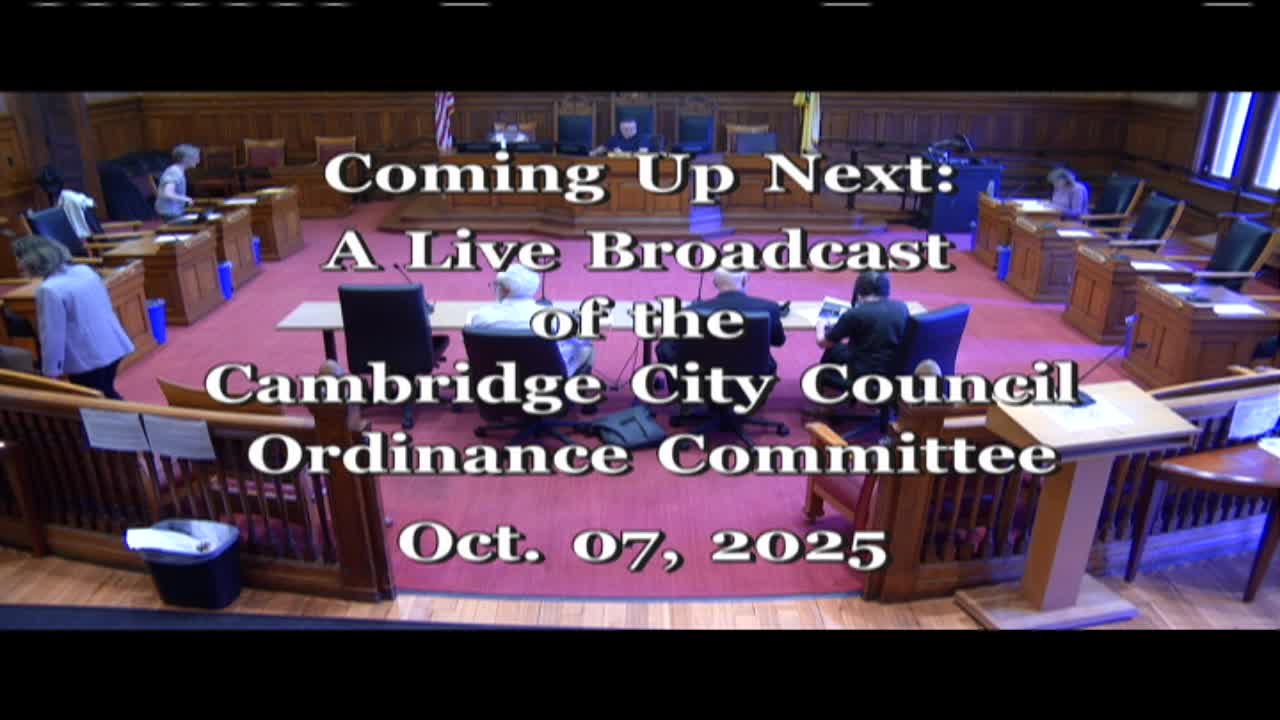
Cambridge ordinance committee hears petition to limit paved paths in open-space parks
Summary
Petitioners asked the Ordinance Committee to amend Cambridge zoning to restrict new paved ways wider than 10 feet in open-space districts and to cap paved-area increases; planning staff advised against the approach and the Planning Board gave an unfavorable recommendation.
Petitioners asked the Cambridge City Council’s Ordinance Committee on a zoning petition that would limit the width and growth of paved ways in the city’s open-space districts, saying the change is needed to protect mature trees and reduce heat in parks.
The petition, filed by Martin Bacall et al., would amend the Cambridge zoning ordinance (sections 4.3 and 4.4) to treat paved ways greater than 10 feet wide as prohibited principal uses in open-space districts and would limit increases in paved ways within a contiguous open-space area to no more than 2 percent of that area within any two-year period. The petitioners also proposed clarifying footnotes around permitted paving materials and site-specific restrictions.
Proponents said the measure is aimed at preserving existing canopy and reducing incentives to over-pave parks. “People should be able to use a park for whatever it’s meant to be used for,” petitioner Martin Bacall said in the committee meeting, and later summarized: “Wider is not faster and faster is not safer.” Petitioners cited the city’s Urban Forest Master Plan (UFMP), examples of tree loss during the 2016 and 2022 droughts, and a study they cited that reported an 18 percent loss in canopy between 2009 and 2018 to make the case for protecting park soils and root zones.
Jeb Mays, a resident of Harvey Street in North Cambridge, told the committee during public comment that neighborhoods bordering Linear Park and other parks already experience faster bicycle and e‑bike speeds and that wider paved paths would further discourage older residents, families with strollers, and people using wheelchairs from using parks. “Green space in Cambridge is very precious,” Mays said. “We do not need more commuter speedways. What we need is parks that are safe for all users.”
Planning staff and the Planning Board urged caution. Jeff Roberts, director of zoning and development in the Community Development Department (CDD), told the committee the Planning Board held a public hearing on Sept. 30 and ultimately voted to send an unfavorable recommendation. Roberts said the board supported the petition’s goals of tree preservation and addressing motorized vehicles in parks but concluded the proposed zoning text would be too rigid and could produce unintended constraints on the city’s ability to design, program and adapt parks. “The board expressed some support of the goals,” Roberts said, and “voted to send an unfavorable recommendation based on the belief that this was not an appropriate approach to take in zoning.”
Assistant City Manager Melissa Peters told the committee that open-space design requires tradeoffs among access, connectivity, play and environmental goals, and that “flexibility is really important” so staff can meet site-specific constraints and ADA obligations. Peters said CDD’s concern is not with the petition’s intent but with creating inflexible zoning limits that could require frequent zoning relief or otherwise prevent designs that the community or staff determine are appropriate for a given park or amenity.
Petition supporters and other speakers pressed two technical points during the discussion: (1) damage to critical root zones (CRZ) when paths are widened or graded, and (2) whether some surface materials marketed as permeable—such as compacted stone dust—remain permeable under sustained pedestrian use. Petitioners and advocates argued that even permeable surfaces require excavation that severs roots and reduces tree survivability; they pointed to examples discussed in the UFMP and to sections of the Linear Park design set they said would require excavation into typical CRZ depths.
Committee members expressed sympathy for the petitioners’ goals but also concern about the zoning mechanism. Councilor Nolan said he supports the intent—tree protection and shade growth—but expressed doubts that a blanket citywide zoning rule focused on paved-way width is the right tool and said other approaches (tree-protection updates, programmatic incentives, or targeted site-level restrictions) might better reach the objective. Councilor Susie said she was “completely sympathetic” to the petitioners and raised Article 97 and the need to preserve open space, but also asked staff how to meet accessibility requirements while preserving trees.
The committee did not take a final vote on the petition. On an unrelated procedural motion to close public comment (moved by Councilor Nolan), the committee voted by roll call to end the public-comment period; the motion passed with six members recorded in the affirmative and three members recorded as absent. The Planning Board’s unfavorable recommendation and CDD’s written memo remain part of the record; committee members and staff said they would continue the policy discussion and consider alternatives that could accomplish the petition’s goals without imposing overly prescriptive citywide zoning constraints.
If the committee advances any formal recommendation or amended text, staff and petitioners said they want a follow-up that clarifies how tree-protection standards (for example, CRZ calculation and best-management excavation practices), ADA access requirements, and the city’s open-space programming needs would be reconciled. Petitioners said they would consider narrower drafting options such as raising the permitted width in targeted locations, using a special-permit process for exceptions, or tying limits to site-specific tree surveys rather than a single numerical rule.
Committee members scheduled no final vote on the zoning petition at the meeting. The matter remains before the Ordinance Committee for additional questions, possible text revisions, and further public comment.