
Committee debates amendment language for SB134 on Medicaid work requirements
Get AI-powered insights, summaries, and transcripts
Subscribe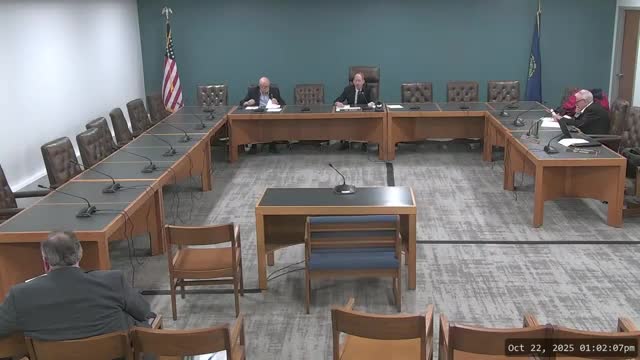
Summary
Members of the Health, Human Services and Elderly Affairs committee reviewed proposed amendment language to SB134 to align state Medicaid work requirements with pending federal rules, focusing on verification, exemptions, timing and administrative burdens. Lawmakers directed further drafting and set follow-up meetings.
At a work session on SB134, the Health, Human Services and Elderly Affairs committee reviewed proposed amendment language intended to align the state's Medicaid work-requirement law with pending federal rules and to narrow areas where state statute could obstruct federal approval.
Representative Cofall, who led the subcommittee discussion, said members had taken several weeks to review a side-by-side comparison of the federal provisions and the state language. He read aloud proposed statutory language and told the panel, "No applicable individual shall be enrolled in Medicaid unless at the time of application the individual demonstrates ... The Department of Health and Human Services shall require documentary evidence and shall not accept self attestation at the time of" application, and then asked the department and members to consider how to implement that requirement.
The committee's discussion centered on several recurring topics: the look-back period for verifying prior work (federal guidance allows states to choose one to three months and Representative Cofall said his draft would set three months); whether DHHS should require documentary evidence rather than accept self-attestation; how to verify compliance on an ongoing basis (the draft directs DHHS to verify at least quarterly); the use of ex parte data (the state using records it already holds to avoid burdening applicants); whether managed care organizations may make exemption determinations; how to define "medically frail" consistent with federal regulation; notice and timing for disenrollment; and a protective clause to defer to federal law where federal statute or regulation preempts state language.
Director Littmann of the Department of Health and Human Services raised operational concerns, including scenarios in which an applicant experiences a sudden medical event and cannot produce prior documentary proof, and the administrative burden of monthly versus quarterly verification. Littmann said certain cases would likely require exemptions and described how ex parte determinations (using records the state already holds) would reduce administrative burden and applicant burden.
Committee members also explored practical questions: how self-employed people would document earnings (bank records, invoices or tax filings were discussed), whether job-search activities and training count as qualifying hours, and whether short-term involuntary unemployment should be treated as a hardship or handled through existing exemption or verification processes. Representative Woods and others pressed for clarity on the mechanism to change requirements later (legislative statute versus administrative rules), warning that some fixes might require a future legislative change or rulemaking.
On process, the committee agreed on next steps: Representative Cofall will revise the draft to (1) broaden the verification language to "documentary evidence" to account for salaried, self-employed and volunteer activities; (2) add explicit ex parte language where the state already holds information; (3) clarify whether the executive council or another body would have authority to approve additional exemptions; and (4) clarify whether loss of coverage for noncompliance is prospective rather than retroactive and the mechanics of notices and the 30-day cure period included in the draft. Cofall said he would submit the revised language to the Office of Legislative Services (OLS) and coordinate review with DHHS and subcommittee members.
Committee leaders scheduled a subcommittee meeting for Nov. 3 to review redrafted language and discussed reconvening the full committee on Nov. 12 (the chair had earlier proposed Nov. 5 or Nov. 12). Members agreed to submit both the earlier amendment (reviewed three weeks prior) and the revised draft to OLS so the full committee would have options available.
No formal votes or final committee actions were taken during the work session; members directed additional drafting and review. The meeting adjourned after scheduling follow-up drafting and meetings.