Get AI Briefings, Transcripts & Alerts on Local & National Government Meetings — Forever.
Council hears plan for Lester Park land-use study; transfer to DITA would be conditional on study and approvals
Summary
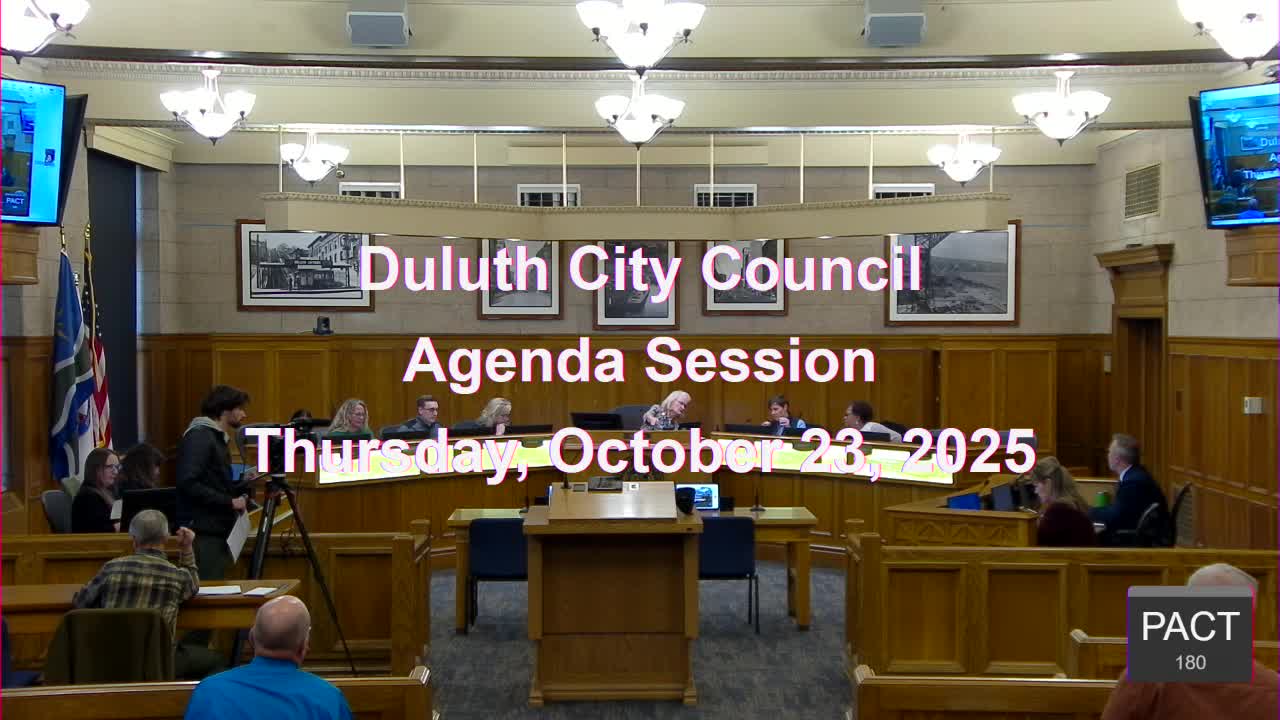
The Duluth City Council considered a resolution requesting a land‑use study for the former Lester Park Golf Course and discussed conditions and safeguards under which the Duluth Industrial and Transportation Authority (DITA) might later take ownership of study‑approved parcels.
The Duluth City Council considered a resolution requesting a land‑use study for the former Lester Park Golf Course and discussed conditions that would govern any transfer of study‑approved parcels to the Duluth Industrial and Transportation Authority (DITA).
Why it matters: The 240‑acre site and an earlier 37.5‑acre parcel have been the focus of long public debate over parks, housing and development. Councilors and staff spent the meeting defining the public engagement steps, the funding source for the study and the legal steps that would be required before any change in ownership or land use could occur.
Council staff read the measure into the record as Resolution 8‑45, “resolution requesting a land use study for the former Lester Park Golf Course.” Manager Moses, who said she also serves as DITA executive director, told council that “DITA will not take ownership of the property until all of those requirements have been met.” That, she said, would include completing the study and any subsequent approvals the resolution requires.
Manager Moses and other staff outlined a multi‑phase process: an RFP to hire a consultant with expertise in natural resources and open‑space planning, community and stakeholder meetings, presentation of the completed study to the Planning Commission and a public hearing before the City Council if future‑land‑use map amendments are proposed. “When the plan is finished, it’ll be presented to Planning Commission and council, and it will have a public hearing because that involves amendments to the comprehensive plan,” Manager Moses said.
Attorney Loehr told council the resolution itself does not convey property. “This resolution does not transfer any property,” Loehr said. He added that any subsequent transfer or deed would require the standard legal steps and a supermajority vote if parkland conveys out of the city’s parks classification: “Any transfer of the property, which may follow the completion of the land use study, has to follow the normal processes. It has to go before the appropriate bodies, and you have to have the majority vote to do the actual transfer.”
Councilors pushed staff on timelines, funding and safeguards. The resolution’s authors asked for a nine‑month target to complete the study after council approval; staff said that timeline was realistic if the RFP and consultant work proceed without delay. Staff estimated a robust land‑use study could cost roughly $200,000 or more.
Funding and ownership questions were a repeated theme. DITA staff and administration said DITA is prepared to fund the study; staff noted the city lacks the staffing capacity and line‑item budget to run a study of this scale without contracting outside support. Councilors pressed whether the city could instead use existing capital funds (for example, a $75,000 parks line in the FY2025–29 capital improvement plan) or reallocate other planned purchases; administrators said those options would require separate budget discussions.
Council discussion also examined a 37.5‑acre portion already under an option agreement with private developer Oppiden. Staff said that parcel is included in the broader study boundary but remains subject to its option agreement; DITA staff said they continue to work with Oppiden under an option that currently expires Dec. 31, 2025.
Councilors asked how proceeds from any future sale would be used. Staff described a proposed split of net proceeds in which 50% would be reinvested in parks maintenance and capital (with parks able to determine the final distribution) and 50% would be placed in a city revolving loan fund to support future development on the site. Swenson asked whether the 50% allocation to parks included a preference for funding at the adjacent Enger Park Golf Course; staff said parks would make that decision.
Multiple councilors and staff emphasized safeguards and public involvement. Manager Moses said DITA would not close on any purchase until the resolution’s conditions — the land‑use study, public hearings and any necessary changes to the comprehensive plan and zoning — were satisfied. “DITA will not take ownership of the property until all of those requirements have been met,” she said. Attorney Loehr reiterated that the resolution sets a path but does not complete a transfer and that a later closing would require the appropriate council vote(s).
The council also discussed process mechanics: Planning Commission was scheduled to consider related matters at a special meeting on Oct. 28; staff said Planning Commission would still likely make a recommendation that could then come to the City Council, which may consider a supermajority vote on any conveyance required by the 1955 legislation that governs parkland conveyances. Several councilors asked administration and DITA to produce a development agreement that would specify the conditions under which DITA would expend funds and when the city would permit a transfer.
What’s next: Staff said a special Planning Commission meeting is scheduled for Oct. 28 to take up related items; if Planning Commission recommends transfer, the matter would return to the City Council for a later vote. Councilors and staff said they expect multiple additional public touch points — stakeholder meetings, public meetings and Planning Commission hearings — before any closing or transfer occurs.
No final vote or transfer was recorded during the meeting; the resolution was discussed and staff were asked to return with details and to work with DITA on funding and the proposed development agreement.