Get Full Government Meeting Transcripts, Videos, & Alerts Forever!
Get email alerts on the City Budget Homelessness topic
No spam. Unsubscribe anytime.
Council reviews homelessness prevention funding, cannabis fund uses and staffing proposals as budget work session continues
Summary
City staff presented a detailed review of homelessness prevention programs, proposed uses for cannabis revenue, payments to agencies, a ‘Little White House’ property and a potential uplift shelter, plus requests for three new staff positions and options for a franchise fee on utility bills tied to a riverfront/city hall funding plan.
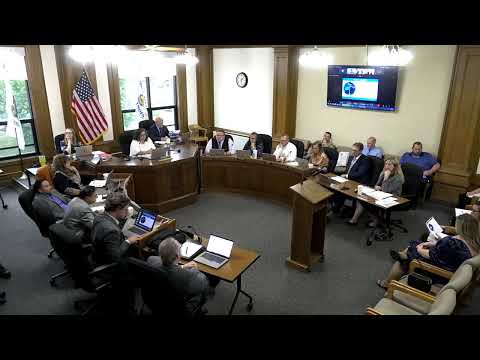
City staff briefed Moline City Council on budget priorities and proposals during a work‑session review of the draft 2026 budget, focusing on homelessness prevention programs, proposed ongoing uses for cannabis‑tax revenue, requests to fund special projects and three requested staff positions.
KJ, a community‑services staff member, outlined current and proposed homelessness prevention efforts. Staff reported about $865,000 budgeted for homelessness prevention in 2026 and roughly $3.4 million projected across 2025–2028 for related programs. Existing and proposed programs include CDBG‑funded homestead and homebuyer assistance, a COVID‑era voucher program, the Moline Urgent Rental/Utility Assistance program and a two‑tier “Level Up” program providing smaller recurring assistance ($400) and one‑time emergency grants (up to $2,000). KJ said demand remains high and that calls, emails and in‑person requests continue despite exhausted funds.
Council considered a staff recommendation to allocate cannabis fund dollars for immediate rental and utility assistance. Staff proposed using $200,000 in cannabis revenue for one‑time assistance dispersed between Oct. 1 and Dec. 31, 2025; within that, the city would allocate $150,000 to continue the Moline urgent rental/utility assistance program and $50,000 to Project Now Affordable Housing LLC to administer Level‑B emergency grants.
Finance staff showed the cannabis fund balance and revenue trends. Yearly cannabis receipts were projected at about $680,000 annually. Staff recommended retaining an initial $200,000 “seed” balance in the cannabis fund rather than repaying it to the general fund to buffer future volatility.
On agency payments and shelter strategies, staff briefed the council that funding recommendations for 2026 include a $50,000 placeholder for an “uplift shelter” (a purchasable non‑congregate shelter unit) and a range of other agency payments; staff said the Little White House property owned by the city is being evaluated for possible uses—shared housing pilot, community worker offices, low‑income housing or other uses—each of which would carry different renovation requirements and costs such as sprinklers and exit signage if used as multi‑occupant housing.
The city’s land bank board reported it will pivot its operating model after a staff resignation. Rather than city‑employed staff, the land bank intends to trial a commission/contract model with a reduced city commitment (a $10,000 budget item) and pursue grants or partner funding for property acquisition and holding costs.
Public‑art and special‑events funds were also discussed. The Public Art Fund includes a proposed Leading Light project expected to use $400,000 of available art funds (with $200,000 anticipated from Metrolink). Staff proposed $60,000 annually for special events in 2026 and suggested a one‑time $100,000 placeholder from council contingency to support America250 celebrations in 2026; staff noted prior donations and fundraising may offset that ask.
Staff proposed three new full‑time positions for 2026: an economic‑development support position to assist deal packaging and riverfront redevelopment; a traffic operations coordinator to help manage more than 100 signalized intersections; and a motor‑equipment operator in parks/public works. The three positions together were estimated to cost roughly $206,000 for 2026 (salary and benefits). Several councilmembers asked to phase or prioritize positions and to examine offsets before finalizing staffing additions.
Finally, staff presented options tied to a previously discussed franchise fee on utility bills (a City‑adopted resolution contemplates a fee phased over years to support a city‑hall and riverfront program). Staff outlined three scenarios: proceeding with the previously planned franchise‑fee schedule (which staff said could make roughly $16.7 million available for city‑hall and riverfront projects over a 10‑year horizon), freezing franchise‑fee increases (reducing available funding to about $6.05 million under the staff scenario), or phasing increases every other year. Staff cautioned that pending utility‑rate filings at the Illinois Commerce Commission could affect final revenue.
Council did not make final budget decisions in this session; staff asked for direction on items to present in the October budget adoption process and for input on whether to retain the $200,000 seed balance in the cannabis fund, how to show agency payments in the proposed budget, and how to prioritize capital and staffing requests.
No formal votes were taken on these budget recommendations during the workshop portion of the meeting.