Get Full Government Meeting Transcripts, Videos, & Alerts Forever!
Get email alerts on the Traffic Calming topic
No spam. Unsubscribe anytime.
NDOT presents final designs for Cumberland Avenue traffic calming; residents ask for extra measures near Bixler Avenue
Summary
Nashville Department of Transportation presented detailed plans Sept. 17 to add four speed cushions, 9-foot travel lanes with edge-line narrowing and a public ballot for Cumberland Avenue; neighbors pressed NDOT to study additional measures between Bixler Avenue and the first cushion because of a downhill speed run and school bus activity.
NASHVILLE — The Nashville Department of Transportation on Sept. 17 presented final plans for traffic calming on Cumberland Avenue, including four modular speed cushions, continuous edge-line narrowing to create two 9-foot travel lanes, and an online ballot that must win at least 66% approval from eligible property owners to move the project into construction.
The designs are intended to reduce vehicle speeds on the corridor, which NDOT staff said records speeds at the high end of neighborhood-street ranges. David Greaves, an engineer with the Nashville Department of Transportation, told residents the project is part of NDOT’s traffic calming program and is designed to support the department’s Vision Zero goal that “nobody should have to be killed or seriously injured on our public streets.”
NDOT described the primary treatments as modular rubber speed cushions, each 6 feet wide and bolted to the pavement, with intentionally spaced gaps to allow larger emergency vehicles to straddle the cushions. Greaves said the city’s limited before-and-after study from 2023 on six projects showed average speeds falling from 31 mph to 22 mph and the 80th-percentile speed falling from 37 mph to 25 mph after cushions were installed.
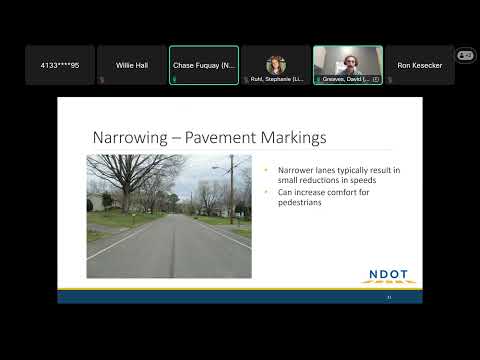
The proposed Cumberland project would extend the treatment along the entire street between Gallatin Pike and the park east of Delaware Avenue. NDOT identified four cushion locations along the corridor. The design includes continuous edge-line narrowing on the western portion to create two 9-foot travel lanes and provide a few extra feet of pavement edge intended to make walking along the roadway less uncomfortable where sidewalks are absent.
Greaves said placement decisions were constrained by several guidelines: cushions are not recommended on grades steeper than about 6–7%, the city maintains a 15-foot clearance requirement from driveways for cushion placement, and spacing rules limit how close cushions may be placed to intersections and to one another. Those constraints, Greaves said, limited where cushions could be located and explain why one identified cushion sits near Bixler Avenue rather than closer to the top of the hill.
Several residents urged NDOT to re-evaluate those placement constraints for the downhill section toward Gallatin Pike. One resident said, “I would second the request that some form of indication between Bixler, the first set of humps be, studied as to as to prevent that outcome transpiring,” noting the risk of high speeds on the downhill run and that a morning school-bus stop is near the corner.
NDOT staff responded that they will re-check spacing and clearance rules and consider additional measures requested by residents, such as: adding pedestrian warning signage at the Bixler intersection, evaluating a possible additional cushion between Bixler and the next cushion to the west (subject to minimum spacing rules), or proposing a radar-feedback speed sign to display drivers’ speeds. Greaves said the agency will verify whether a pedestrian sign meets the relevant guidelines and, if appropriate, include it in the design.
Residents also asked about other design options considered earlier, such as traffic circles and corner bulb-outs. Greaves said a traffic circle is not feasible at Bixler because the existing pavement is not large enough to accommodate turning movements for larger vehicles, and bulb-outs would not reclaim sufficient space at that intersection to be effective.
NDOT described the public balloting and timeline. Ballots are mailed to owners of residential properties, churches and schools that touch the affected right of way; each owner receives one unique mailer and property owners of commercial-facing lots are excluded. Greaves said NDOT uses register-of-deeds records and updates mailing lists multiple times (for meeting invitations, meeting two notices and again before the ballot) to reflect recent changes in ownership. Ballots are typically open for roughly six weeks; a 66% yes vote of returned ballots is required for the project to advance to the construction queue. Greaves said construction will follow but may take about eight to 10 months after successful ballot approval due to the existing pipeline of projects.
NDOT said postcard mailers will display a QR code and a unique ID to prevent duplicate votes; the tracker on trafficcalming.nashville.gov will change status when the ballot opens. Greaves said the postcard headline and QR code text are provided in English, Spanish and Turkish, and that the nashville.gov site can be translated into other languages to accommodate non‑English speakers.
NDOT emphasized that the design team will take residents’ concerns into account before finalizing plans and sending ballots. Greaves closed by saying the meetings exist to gather neighborhood feedback and “ultimately, this is a a project for you all.”