Get Full Government Meeting Transcripts, Videos, & Alerts Forever!
Get email alerts on the Judicial Procedure topic
No spam. Unsubscribe anytime.
Tennessee high court hears dispute over Rule 37 certified questions and seizure on anonymous tip
Summary
The Tennessee Supreme Court on Friday heard competing arguments over how strictly courts should apply Rule 37’s “scope and limits” requirement for certified questions and whether an anonymous 2018 tip that led to a traffic seizure in Polk County provided enough corroboration to support the stop.
The Tennessee Supreme Court on Friday heard competing arguments over how strictly courts should apply Rule 37’s “scope and limits” requirement for certified questions and whether an anonymous 2018 tip that led to a traffic seizure in Polk County provided enough corroboration to support the stop.
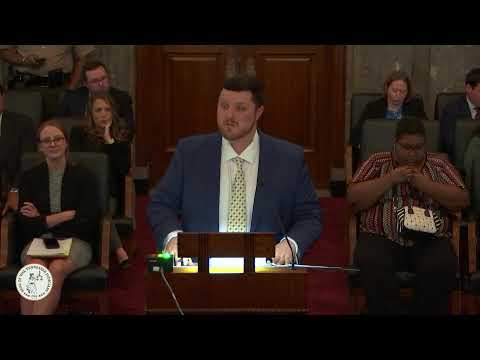
Austin Hayes, identified in court as counsel from the McMinn County Bar and co-counsel on the trial-level proceedings, told the justices that the case arose from an anonymous 9-1-1 call in 2018 in Benton, Polk County, reporting a speeding truck. Hayes said the trial court concluded there was a seizure and that an agreed order, signed by the trial judge and both parties, described the facts and suppression issues. "If that stop goes away, the DUI can't go forward," Hayes said, describing the parties' shared view that the certified question would be dispositive in this case.
An attorney for the state, Mr. Pallietier, responded that the court should read the certified question together with the record and that the question as drafted must provide the Court enough information "so that the Court can read the question in conjunction with the record and know what is being addressed." He argued some certified questions have baked-in factual premises that contradict the record and noted that appellate precedent varies on whether the reviewing court may consult the record beyond the text of the certified question.
The argument centered on two interlocking issues: (1) how narrowly or broadly to interpret Rule 37’s "scope and limits" requirement — that is, what the certified question must contain so an appellate court can answer it without straying into factual disputes — and (2) whether the Polk County facts, which Hayes described as an anonymous tip that supplied a vehicle make, color and license plate and an officer’s later corroboration, met the standards to support a seizure and therefore suppression.
Hayes urged the court to adopt a more permissive standard that would allow the court to consider not just the question but also accompanying materials such as a statement of the case, the motion to suppress, and the trial court’s order. "I would ask for a new standard that allows the court, when determining the scope and limits, to also include not only the question, but also maybe the statement of the case, or maybe the motion to suppress along with the judge's order on that," Hayes said. He argued that defendants, prosecutors and trial judges often agree that a question is dispositive and that the rule should respect that practical reality to avoid unnecessary trials in small counties.
Pallietier said a flexible "question plus record" approach could work in many cases but cautioned that the certified question should still be drafted to enable the appellate court to identify what pretrial ruling is at issue. He pointed to decisions from the Court of Criminal Appeals that, in his account, adopted a "four corners" approach, refusing to look beyond the text of the certified question in some instances. He said that tension between precedent means the Supreme Court could clarify whether the Court of Criminal Appeals may consult the trial record when that is necessary to determine whether a certified question is dispositive.
Several justices pressed both advocates for specifics. The court asked whether the existing cases set a standard of strict compliance or allow substantial compliance. Hayes invoked a Harris-era standard and urged some modest loosening, saying a defendant should not have to “comb the whole record” but that a concise package (question, motion to suppress, judge’s order, agreed statement) should suffice. Pallietier agreed that simpler cases can tolerate simpler questions but said complex cases require more targeted statements directing the appellate court to the precise ruling being certified.
On the underlying facts, Pallietier told the justices the record showed the 9-1-1 caller provided the vehicle’s make, color and license plate and that the officer later encountered a vehicle matching those details. He argued that some language in the certified question — for example, characterizing the tip as "unidentified" or "uncorroborated" — may contradict the record and thus present a problem for answering the certified question on its written terms.
Hayes said the trial court’s suppression order described the tip as "uncorroborated" and that the parties had explicitly agreed the question would be dispositive: "We drafted it in a way just to hear it on the merits because that's what everyone wanted to happen," he said.
Both advocates told the justices that broader rulemaking might be the appropriate venue for sweeping reform, but that the court could also clarify existing doctrine. Pallietier suggested practical steps the trial courts could take, like fuller on-the-record plea‑ or certification-style colloquies in which the prosecution states on the record whether it would continue the prosecution without the challenged evidence; he described that as a "belt-and-suspenders" measure to create a clearer record of dispositiveness.
The justices did not announce a decision at the argument. The court heard roughly 80 minutes of argument from the two sides and questioners, and then moved to the next matter on the docket.
Why this matters: Rule 37 certified questions provide a narrow, expedited route for a defendant to seek appellate review of a pretrial ruling that the parties and trial judge agree is dispositive. How the state and courts interpret the rule affects the use of conditional pleas, the ability to obtain immediate appellate review, and the frequency of bench or jury trials in resource-constrained counties.
The court’s forthcoming decision could clarify whether appellate courts should routinely consult the trial record in addition to the certified question, whether parties can bind the appellate court to factual premises in a certified question, and what a defendant must include to show a question is dispositive.