Get Full Government Meeting Transcripts, Videos, & Alerts Forever!
Get email alerts on the Public Finance topic
No spam. Unsubscribe anytime.
GFOA presents Monte Carlo reserve study; consultant says Bloomington’s reserves are near a ‘Goldilocks’ ceiling
Summary
The city’s finance team presented a GFOA‑led Monte Carlo analysis of fund reserves, which concluded Bloomington’s general fund reserve is near a modeled ‘ceiling’ (about 53% confidence threshold) and that the city could hold slightly less and still maintain AAA expectations.
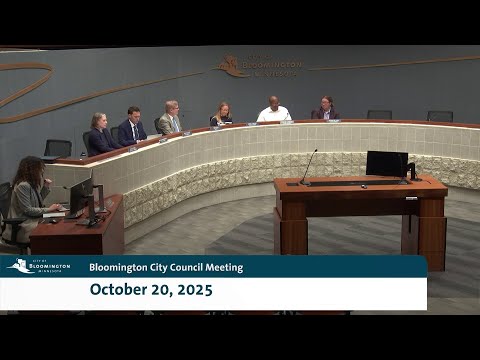
Bloomington finance staff and the Government Finance Officers Association (GFOA) presented a risk‑based reserve analysis to the City Council on Oct. 20 that used Monte Carlo simulation to test how the city’s fund balances would perform against a wide range of adverse events over a 10‑year horizon.
Shane Kavanaugh, senior manager of research at GFOA, told the council the analysis treats reserves like an insurance policy: they exist "to help us manage volatility and risk — those unplanned unavoidable costs and losses." The model runs thousands of simulated 10‑year scenarios varying the frequency and severity of events (recessions, storms, retained insurance risk, large legal judgments and other shocks) to estimate how likely the city’s reserves are to stay above a critical threshold tied to rating‑agency expectations.
Kavanaugh said the simulations indicate Bloomington’s current general‑fund reserve sits near a modeled ‘‘ceiling’’ (about the 53rd percentile on the consulting chart), meaning the city currently holds roughly the level that produces a high confidence of staying above the threshold tied to AAA ratings. He described a range the study labels as the “Goldilocks” zone and said the city could hold somewhat less and remain at a reasonable confidence level — for example an 80 percent confidence level is often treated as a reasonable minimum in other governments — but that the council should weigh its risk tolerance.
Staff also noted the model accounts for mitigation actions (expenditure cuts, FEMA and other reimbursements, revenue performance) and that data inputs included Bloomington’s own historical experience, county hazard plans, insurance loss records and third‑party datasets. The model includes an "unknown‑unknowns" component to capture risks that are not readily specified in advance.
Kari Carlson, deputy finance officer, said the city will receive comparable analyses for other funds (utilities, fleet, facilities) and staff plans to return in November with recommended target ranges for reserves across all funds, enabling the council to set policy‑level reserve goals.
Council members asked practical questions about how the model treats planned capital spending versus timing risk, how comparisons align with other AAA cities and how climate change or other trends alter modeled event frequencies; Kavanaugh said the model can increase event frequency over time or add an unknown‑unknowns module to capture emergent risks. Carlson told the council the city will use the study to inform target ranges and report back with fund‑level recommendations in November.