
State and federal advocates brief board on 2025 legislative changes; officials warn of Medicaid, SNAP and funding uncertainty
Get AI-powered insights, summaries, and transcripts
Subscribe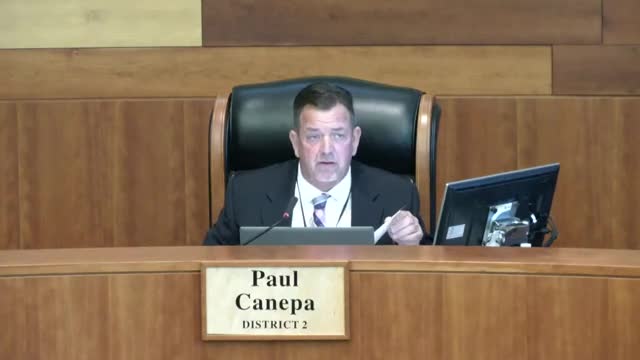
Summary
County advocacy teams presented a state and federal legislative overview and warned that recent state and federal actions ' including HR1 at the federal level and California budget choices ' could change Medi-Cal, SNAP and other program funding and impose county costs; the board accepted the reports 5-0.
San Joaquin County's state and federal advocacy teams presented an end-of-session review and a federal appropriations update on Oct. 21, telling the Board of Supervisors that a mix of state actions and federal legislation could affect county budgets and service delivery.
Hillary Crowley, the county's legislative officer, introduced the state advocates from Shaw Yoder Antwiesch Melzer & ' Lang and multiple federal consultants. Paul Yoder and a colleague summarized California's 2025 legislative session, highlighting a historically low gubernatorial veto rate and a set of high-profile energy, wildfire and transportation bills. Yoder said the governor appropriated about $50 million for Proposition 36 implementation and roughly $151 million for public defenders; he and colleagues urged the county to continue pressing for fuller funding because current allocations do not meet implementation needs.
State advocates told the board that several items of local interest were left unresolved or pushed into the next legislative cycle, including uncertainties around the state's implementation of a housing and homelessness program and changes to utility rules. The Delta conveyance proposal the governor had prioritized did not proceed in its original, expansive form, the advocates said.
On the federal side, David Wetmore briefed the board on HR1 (the reconciliation package) and other actions in Washington, D.C. Wetmore said HR1 makes policy changes that could substantially affect Medicaid/Medi-Cal administration, the Supplemental Nutrition Assistance Program (SNAP), and federal disproportionate-share hospital (DSH) funding. He warned that the reconciliation changes include: freezes/reductions in certain provider taxes and modifications to Medicaid funding mechanisms; new administrative burdens such as more frequent eligibility redeterminations that could shift callbacks and administrative cost to counties; and potential reductions in DSH payments that support county safety-net hospitals. "This bill did not extend those benefits ... That program has now lapsed $8,000,000,000 in cuts across the country," Wetmore said, referring to DSH timing and federal funding uncertainty.
Wetmore and other federal advocates also described an unfolding federal funding crisis: Congress had not completed its annual appropriations work and a partial shutdown threatened program continuity. They listed immediate impacts that can ripple to county operations, including risk to WIC and SNAP benefits, the National Flood Insurance Program and other services. "We're in day 21 of the government shutdown," one federal advocate said; staff noted that actions such as redirected tariff receipts and emergency moves by the president have mitigated some near-term disruptions but that continued uncertainty could force local operational changes.
Board members sought specifics about how county programs might be affected and pressed the advocates for next steps. Supervisors were told that the county should prepare fiscal estimates for proposed bills and maintain contact with the county's state and federal delegation. The board unanimously (5-0) accepted the oral reports and directed staff to continue advocacy and to return with cost-impact data as bills evolve.
Ending: County advocates said they will continue to track changes closely and work with the county to develop fiscal estimates and funding requests; supervisors asked for updated briefings if federal or state actions would create direct costs for county services.