Get Full Government Meeting Transcripts, Videos, & Alerts Forever!
Guam officials describe scope of dieldrin detections, testing and treatment plans
Summary
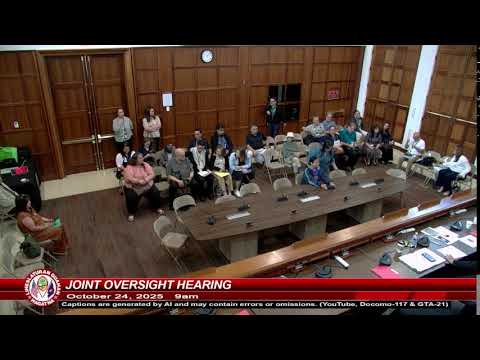
At a legislative oversight hearing, Guam Water Works Authority, Guam EPA and Department of Public Health officials described detections of the pesticide dieldrin in multiple wells, steps taken to isolate affected zones, sampling results, and plans for treatment and public health follow-up.
At a Guam Legislature oversight hearing, officials from the Guam Water Works Authority (GWA), Guam EPA and the Department of Public Health told senators that the pesticide dieldrin has been detected in multiple groundwater production wells and that efforts are underway to isolate affected distribution zones, increase testing and deploy point-of-entry and permanent treatment systems.
GWA operations staff said the authority’s distribution system “is a combined, distribution system where the wells pump directly into the piping that goes to domestic supply,” and that water from multiple wells is blended in the pipes, which makes tracing the path of water to individual customers complex. GWA said it used valve closures and a booster pump to isolate part of the Santa Rosa pressure zone and move water not affected by the Y‑15 well into the southern portion of the zone, temporarily taking some customers off Y‑15.
The hearing focused on how far dieldrin-contaminated water may travel in the distribution system, GWA sampling results, and health risks. GWA reported that of 124 tested locations, 32 were non-detect for dieldrin; about 83 locations had detections at or below 50% of the interim action level (IAL); and nine locations tested above 50% of the IAL. Officials identified three wells highlighted in the briefing as Y‑15, D‑17 and M‑4. GWA said Y‑15 typically produces about 600 gallons per minute and that the authority has installed temporary treatment at Y‑15; treated effluent from Y‑15 is now testing non-detect for dieldrin.
Evangeline Nuhan, identified in the hearing as a senior regulatory analyst, corrected a scheduling point about testing frequency: “It just depends on the constituent that we’re testing…
Already have an account? Log in
Subscribe to keep reading
Unlock the rest of this article — and every article on Citizen Portal.
- Unlimited articles
- AI-powered breakdowns of topics, speakers, decisions, and budgets
- Instant alerts when your location has a new meeting
- Follow topics and more locations
- 1,000 AI Insights / month, plus AI Chat