Building Code committee backs emergency-rule updates to allow A2L refrigerants in split HVAC systems
Loading...
Summary
The Washington State Building Code Council's NDPE committee voted Oct. 10 to recommend modifying an existing emergency rule for the 2021 International Mechanical Code to align with recent ASHRAE 15 clarifications on A2L (mildly flammable) refrigerants and asked staff to pursue a path to incorporate similar language into the 2024 code.
On Oct. 10, 2025, the NDPE committee of the Washington State Building Code Council recommended that the full council establish an emergency basis to modify an existing emergency rule for the 2021 International Mechanical Code (IMC) to reflect recent clarifications in ASHRAE 15 about A2L refrigerants, and separately recommended staff pursue a pathway to add corresponding language to the 2024 IMC filing (CR 102).
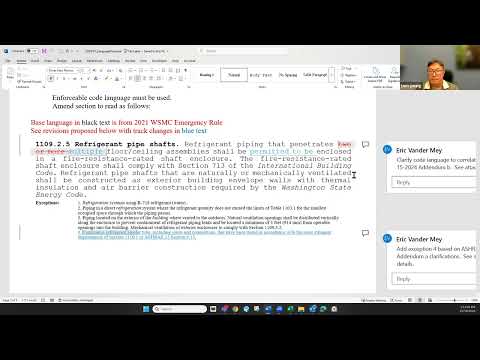
The change seeks to align IMC Chapter 11 with ASHRAE 15 addenda that distinguish continuous refrigerant piping from other equipment and relax, in some cases, the requirement to enclose refrigerant piping for split systems — such as mini-split heat pumps and variable refrigerant flow (VRF) systems — in rated vented shafts. Eric Vandermee, proponent and consultant with Delta E Consulting, told the committee, "The mechanical code chapter 11 requires compliance with both the mechanical code and with ASHRAE 15, and ASHRAE 15 is a continuous maintenance standard." He said the recent addenda clarify when rated shafts are not required for continuous pipe and tube that has been pressure-tested per ASHRAE 15 and Chapter 11 requirements.
Why it matters: committee members said the change could reduce construction costs for certain HVAC installations while retaining nationally vetted safety standards. Ben O'Meara, a committee member, summarized the case for the amendment as both affordability and safety: "it's both an affordability as well as a safety type of basis for the new receivable." The committee voted to recommend the emergency-basis modification and to direct staff to propose a pathway for adding comparable language to the 2024 code's CR 102 filing.
Details of the technical change: the proposed amendment adopts language from ASHRAE 15 addenda that (1) distinguish piping that is continuous pipe or tube, including joints and connections, from systems with components that present higher leak potential; (2) recognize that continuous piping that meets pressure-test requirements need not be enclosed in a rated shaft; and (3) permit but do not require rated shafts for some installations. Committee discussion emphasized that the IMC and ASHRAE 15 overlap in places and that officials are instructed to enforce the more stringent applicable requirement where differences exist.
Public comment and standards timing: Patrick Hanks of the Building Industry Association of Washington was present for public comment. Prashant Inamdar, representing Rheem Manufacturing and a voting member of ASHRAE PC 15, asked the committee to note that the referenced ASHRAE addendum (addendum b to ASHRAE 15 for the 2024 edition) had been in public review and was not yet finalized; he cautioned the committee that the language could change during subsequent public review. Committee members acknowledged that concern but said the current draft language largely reflects the second public review draft and is unlikely to change materially; they also noted there are mechanisms for editorial changes later if necessary.
Motions and votes: the NDPE committee moved, seconded, and approved a recommendation to the full council to establish an emergency basis and modify the existing emergency rule for the 2021 IMC to incorporate the clarifications described above. The committee also approved a motion recommending that staff pursue a path to include equivalent language in the 2024 code CR 102 filing and report back to the council on the procedural approach. Both motions carried with all committee members present voting in favor.
Next steps: the committee will forward its recommendation to the full Building Code Council; the council is scheduled to consider the emergency basis and the substance of the proposed amendment at its next meeting. Staff indicated they will consult with legal and rulemaking staff (referred to in the meeting as Dirk) about the precise procedural path for folding the language into the 2024 CR 102 filing or otherwise addressing the timing if ASHRAE issues further revisions. In other business, committee members noted an unrelated industry concern about how changes to federal or California regulatory waivers could affect Washington's EV requirements; staff said they would follow up.
The committee meeting was conducted online and included representatives from industry and manufacturers; the committee recorded consensus that the proposed language provides necessary clarification for safe, cost-effective installations while the council resolves the formal rulemaking path.