Get Full Government Meeting Transcripts, Videos, & Alerts Forever!
Get email alerts on the Childcare Fire Area Sprinklers topic
No spam. Unsubscribe anytime.
Building Code Council to review petition on how childcare occupant loads affect sprinkler and fire-area calculations
Summary
The Washington State Building Code Council’s BFRW committee discussed a petition from a Seattle fire official asking the council to clarify how a 2024 change to state law affects calculation of occupant loads, fire areas and sprinkler triggers for child care in existing buildings.
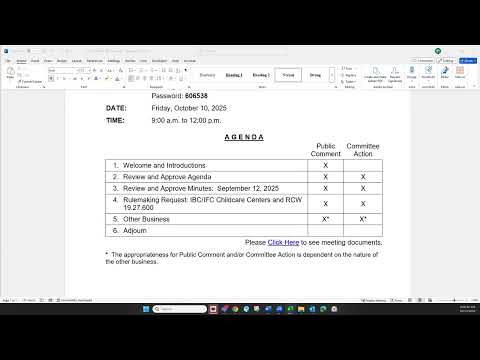
The Washington State Building Code Council’s (SBCC) Building, Fire, Accessibility, and Residential Working (BFRW) committee heard a petition on Oct. 10 asking the council to consider rulemaking or an official interpretation about how a 2024 change in state law affects fire-area and sprinkler calculations for child care in existing buildings.
Ken Broullette, a member of the City of Seattle Fire Department, told the committee he is seeing confusion among building officials about whether the statute allows child care operators to calculate occupant load only for the child-care space or whether occupant loads from the remainder of an unseparated building must also be included when determining whether sprinklers are required. “You are not going to go outside of my space and include that occupant load too. You're only gonna include that occupant load in that daycare area,” Broullette said, describing the interpretation he believes the legislature intended.
Dustin (committee staff) summarized how the petition is being handled: “This one didn't come with any rule language, but the way I'm running with this one is that this is a chance for the committee to review the petition before it gets introduced at the council meeting next week.” Staff told members the petition can be introduced to the full council next week and that the committee could return in November with draft WAC (Washington Administrative Code) language if members want rule language to accompany an emergency-rule finding.
Committee members discussed technical code sections implicated by the petition, including Chapter 9 (fire protection systems), Chapter 5 (mixed occupancies), the Section 903 sprinkler thresholds and the Section 907 fire alarm provisions. Committee members noted the state’s occupancy threshold for requiring sprinklers in E (educational/daycare) occupancies is 51 persons under the state calculation (using a 35 net occupant load factor), and that a statutory exception exists for some day care and preschool facilities with direct exits and a document load of 100 or less. Several members said Washington’s thresholds are more restrictive than the Model Code (which can be 300 occupants in comparable situations).
Members debated whether the issue could be resolved by an official interpretation from SBCC staff or whether substantive changes would require rulemaking in Chapter 9 or related building-code chapters. Some members said an interpretation would be quicker but not carry the same permanence as WAC language. Others said that because the statutory change flowed from the 2024 legislature and touches multiple code sections (including different rules for I-4 versus E occupancies and the Section 907 provisions for children under 2½), rulemaking could be necessary to create clear, consistent code text.
The committee agreed to introduce the petition at next week’s full council meeting with a concise statement that an emergency basis exists (staff said introduction does not require draft WAC language), and asked Broullette to draft two possible WAC approaches for committee consideration: one allowing child care in unseparated spaces without carrying the rest of the fire-area occupant load into the sprinkler calculation, and another approach that would retain the current fire-area calculation (i.e., include the entire fire area in sprinkler triggers). Broullette said he would try to provide draft language by the Monday before the council meeting and to run it by Micah (another jurisdictional reviewer) before submitting it to staff.
Committee members said they would also reach out to legislators identified as having sponsored the statutory language to clarify legislative intent. Dustin said the committee could consider using the consistency-with-state-law basis for emergency rulemaking if the council determines that route is appropriate, but noted that legal staff (Derek) should be consulted on the precise statutory basis for any emergency finding.
The committee did not take a final rulemaking vote at the meeting. Instead it agreed to proceed with introduction of the petition to the full council and to develop proposed WAC language and additional information for the November BFRW meeting and the November council meeting.