Get email alerts on the City Budget topic
No spam. Unsubscribe anytime.
Superior mayor presents 2026 budget with levy decrease; council postpones final vote, sets Nov. 4 hearing
Summary
Mayor Payne presented the city’s 2026 budget on Oct. 7, emphasizing a projected 1.55% levy decrease, investments in firefighter mental health, lead-line funding and broadband. Council voted to postpone final adoption and set a public hearing for Nov. 4.
Mayor Mark Payne presented the city of Superior’s proposed 2026 budget to the Common Council on Oct. 7, 2025, outlining a general fund plan, a five‑year capital improvement program and several targeted funds, and said the proposal would reduce the city levy by about 1.55% — roughly $200,000 — compared with the current year. After discussion and questions from council members, the council voted to postpone final adoption and set a public hearing for 6:30 p.m. on Nov. 4, 2025.
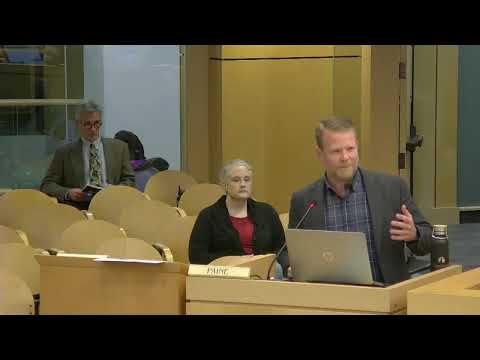
Payne told the council the budget book before them is a draft from the mayor’s office but presented as his final proposal. “The budget is the largest policy we will pass throughout the entire year,” Payne said, urging councilors to take at least two weeks to review the documents and to flag errors or omissions.
The mayor highlighted key elements of the package: a recommended 2.8% nonunion wage increase that the Human Resources Committee endorses; a $50,000 allocation to seed a part‑time community service officer program in the police department; approximately $100,000 in carryover for a tourism coordinator benefits package (with salary proposed to be shared with the tourism commission if that position is created later); and dedicated funds for firefighter mental health programs. He also proposed a new lead‑line replacement fund seeded with $100,000 in 2026 and ramping to larger amounts in later years.
Payne described the capital program’s major items and funding approach. He said the fire station project is large — “the reason the fire hall costs $10,000,000” — and that the budget anticipates bonding for that project and for a proposed golf course irrigation system (the mayor cited $4,000,000 as a potential golf course figure). The mayor said he had proposed bonding to spread large capital costs over time and noted the city will consider revenue options to repay parts of those bonds, including golf course revenues for irrigation work.
On revenue, Payne said the proposed levy decrease reflects debt service falling off the books as prior bonds are paid down: “We have paid down a lot of debt. That is a plan we made several years ago. It is coming to fruition.” He also cited modest, conservative growth assumptions for the terminal tax and overall revenues and said the city closed 2024 with a surplus of about $1.7 million, some of which was moved into the CIP.
Councilors asked detailed questions during the presentation. Councilor Elm pressed the mayor on how the 1.55% levy decline was achieved; Payne attributed it primarily to lower debt service. Councilor Franisi questioned how new bonding for large projects would be reflected in future years; the mayor and finance staff said the fall presentation shows aggregate projections with conservative growth rates applied across line items and that future budgets will include more detailed debt‑service scheduling. Councilor Sweeney asked about the newly proposed legal liability fund and whether written guidance sets limits on its use; Payne and staff said the fund is intended to pay deductibles, outside counsel and settlement costs as needed and that council approval is required for larger settlements.
Other notable budget elements Payne mentioned: a Connect Superior expansion (municipal broadband) budgeted modestly for 2026 with larger buildout in later years; a small parks accounting shift to reflect the skate park; and a revolving grant fund (small business, parks, public art and nonprofit grants) funded from surplus. On lead lines, Payne said the initial program area with Superior Water, Light & Power could be eligible for loan forgiveness under a state grant, meaning 2026 could require minimal direct local expense, but the city is establishing a fund so staff can act quickly on opportunities.
After discussion, Councilor Herrick moved to postpone final adoption of the budget; Councilor Elm seconded. The motion to postpone carried on voice vote. Councilor Elm then moved — and Councilor Ladin seconded — a resolution setting a public hearing on the proposed 2026 general fund budget for 6:30 p.m. on Nov. 4, 2025; the council approved that resolution by voice vote.
Votes at a glance (motions recorded in council minutes): - Motion to postpone final adoption of the 2026 budget: mover Councilor Herrick; second Councilor Elm; outcome: passed (voice vote). - Resolution to set public hearing on the proposed 2026 general fund budget for 6:30 p.m. Nov. 4, 2025: mover Councilor Elm; second Councilor Ladin; outcome: approved (voice vote). - Human Resources Committee recommendation to approve a 2.8% wage increase for nonunion employees: approved by council (Councilor Herrick recused from that item). - Human Resources Committee recommendations to open a museum director position and to approve a shared services agreement with Douglas County (Third Floor receptionist): approved by council as a group. - Finance Committee recommendation to award a $5,000 grant to the Humane Society of Douglas County: approved by council. - Public Safety Committee ordinance amending Chapter 112 (streets excluded from calendar parking) to add 50 Third Avenue East at East First Street North, as amended: adopted by council. - Communications & IT Committee recommendation to approve a wholesale broadband agreement with Norvado Inc.: approved by council. - New business licenses (A & T Jacks Bar — Class B liquor and cigarette/tobacco/vape retail): approved pending departmental sign‑offs. - Fire department MOU with The Nature Conservancy for wildland fire management and stewardship activities: approved by council.
Discussion vs. decision: The council’s action on Oct. 7 was procedural — the mayor presented a full budget package but recommended the council not adopt it that night. The council followed the mayor’s suggestion and postponed final adoption to allow time for review; a public hearing was scheduled. The Human Resources committee’s wage recommendation and a number of committee items were approved by council during the same meeting.
Background/why it matters: The 2026 budget contains both operating choices (wages, firefighter mental health, part‑time community service officers) and capital proposals (fire station, golf course irrigation, Connect Superior, lead‑line fund) that will affect the city’s property tax levy, services and borrowing plans. The levy decrease the mayor proposed is notable because it reflects debt reductions; council discussion focused on how new borrowing for large capital projects would be scheduled and repaid in future budgets.
Ending: Council members were urged to review the budget documents and return specific comments to the mayor’s office or finance staff; the council will take further action after public comment at the Nov. 4 hearing.
AI generated
The text on this page is AI generated. Summaries, highlights, analysis, and video transcripts are all produced from the original source material.
AI can make mistakes, so if you spot one, and we will fix it for everyone.
Note: the source content is unaltered by us. Any content source we link to, be it a video, an audio recording, or a document, is presented exactly as its publisher released it. That publisher is usually a government body, sometimes an individual official or another organisation.