Get Full Government Meeting Transcripts, Videos, & Alerts Forever!
Get email alerts on the Wildfire Risk Cwra topic
No spam. Unsubscribe anytime.
Agoura Hills approves community wildfire risk assessment, moves toward CWPP and grant-backed mitigation planning
Summary
The City Council approved the 2025 Agoura Hills Community Wildfire Risk Assessment (CWRA), a data-driven inventory of fire hazards, vulnerabilities and community concerns, and instructed staff to proceed toward a Community Wildfire Protection Plan (CWPP) that will prioritize mitigation and unlock grant funding.
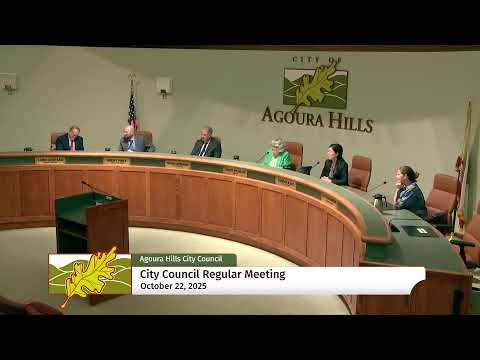
The Agoura Hills City Council voted unanimously to approve the city’s 2025 Community Wildfire Risk Assessment (CWRA), authorizing staff to use the report as the technical foundation for a Community Wildfire Protection Plan (CWPP) and follow-on mitigation work.
Jensen Hughes, the consultant that prepared the assessment, presented maps and models showing where historic ignitions, wind-driven fire flow paths and fuels create the highest hazard and risk within and surrounding the city. "The CWRA is kind of a unique creature," David Kerr of Jensen Hughes told the council, summarizing how the assessment ties modeled fire behavior to community values and infrastructure.
Why it matters: The CWRA maps hazard (modeled flame lengths and fireline intensity), exposure (buildings, critical infrastructure, natural resources and roadways) and risk (the combination of hazard and exposure). The report identifies Liberty Canyon and portions of Chesebro Canyon and the northeastern slopes above the city as areas with relatively higher modeled risk; it also highlights vulnerabilities such as narrow access roads, locations with limited evacuation options, and older homes that predate current wildland-interface building standards.
Key findings and public input: Jensen Hughes reported that 381 residents responded to a community survey. Highlights included that 37% of respondents said they live in areas with only one way in or out, 44% said they do not feel prepared for wildfire today, 63% were not aware of LA County’s alert system, and 84% were not aware of free home-ignition-zone evaluation programs. Consultant and staff briefings also stressed that embers — small burning particles carried ahead of a fire front — caused ignitions during the 2018 Woolsey Fire and remain a principal risk to structures even in parts of town that are not immediately adjacent to wildland fuels.
Council action and next steps: The council approved staff’s recommendation to accept the CWRA and move forward with development of the CWPP; council members asked staff to prioritize the CWPP’s project list so the city can pursue state and federal mitigation grants. City staff said grant funding for the CWPP has already been earmarked and that a subsequent phase will convert CWRA recommendations into spatially explicit projects, with cost estimates, schedules and maintenance plans.
Recommendations in the report: The CWRA contains a set of multi-topic recommendations including public education and outreach to increase defensible space and home hardening; interagency coordination for vegetation management along primary evacuation routes and state-owned corridors; strategies to reduce ignition sources (for example, near trailhead parking and along the 101 Freeway); systems to address evacuation communications and redundancy; and mechanisms to pursue grant funding and interagency projects through MRCA, LA County Fire and federal programs.
Public comment and urgency: Jay Krecher, a local advocate, urged urgency. "I'm speaking tonight with a sense of urgency and not panic about the community wildfire risk assessment and the forthcoming community wildfire protection plan," he told the council, urging faster outreach and more public engagement. Council members agreed on the need to act quickly and to convene stakeholders to prioritize projects that can be funded and implemented.
Implementation risks: Staff and consultants noted implementation will require coordination with multiple land managers (Los Angeles County Fire, MRCA, National Park Service and Caltrans where state right-of-way is involved), grant-writing capacity, and public buy-in for home-hardening and defensible-space measures. The council instructed staff to return with a plan to prioritize projects for near-term grant applications and to consider an ad hoc or subcommittee structure to shepherd the CWPP development.
Outcome: The council approved the CWRA by unanimous roll call vote and directed staff to proceed with next steps toward a CWPP and a prioritized, fundable mitigation program.