Perkiomen Valley SD administration and principal lay out high school renovation priorities and 10-year capital plan
Loading...
Summary
Dr. Fuller presented a broad renovation vision for Perkiomen Valley High School — from a maker space and LGI to an expanded auditorium, upgraded music and athletic spaces, and a security vestibule — while district administrators reviewed a proposed top-30 capital projects list and funding status.
Dr. Fuller presented a “dream big” vision for Perkiomen Valley High School, outlining changes to the library, auditorium, music wing, athletic spaces and main office that he said would improve teaching, performance and accessibility.
“I was asked to dream big for this, presentation. And so I'm telling you everything I would like to do if I could,” Dr. Fuller said as he described proposals including a maker space in the library, flexible student/teacher work areas, a large-group instruction (LGI) room, and an expanded, universally accessible auditorium and lobby.
Fuller described music-area changes that would move or enlarge the band room to provide direct outdoor access for rehearsals and storage for large instruments and set pieces, convert the orchestra rehearsal area into a dedicated music room and expand the theory room. He said the choir room “remains pretty untouched” but that band and orchestra facilities need larger rehearsal space and improved storage.
For athletics, Fuller outlined an expanded fitness center, replacement of worn equipment, and locker-room upgrades. He said the boys’ locker room had “locks we’ve had a couple of thefts pretty recently” and that current lockers are too small for some sports equipment. Fuller also recommended improvements to the auxiliary gym sound system, spectator bleachers, streaming technology and an enlarged wrestling room.
Fuller proposed renovating the main entrance to provide a security vestibule and to reorganize the main office for better customer service, relocating conference rooms and teacher work areas, and relocating bathrooms to reduce congestion in public office corridors.
Committee members sought prioritization. Fuller replied that the presentation was organized by building geography rather than priority, but he listed higher priorities as cost-effective cosmetics and critical items such as asbestos remediation under old tile, locker removal, auditorium and music areas, the fitness center, library upgrades and a security vestibule.
Administrative staff then walked the committee through the district’s overall capital plan and the latest “top 30” list of prioritized projects. The district showed a 10-year history of capital investment, noting nearly $55,000,000 reinvested into the district’s buildings over the past decade through committed general-fund capital and bond/ESCO projects. The administration said it is not recommending a new bond issue at this time but is exploring an ESCO 6 to fund efficiency projects and capital avoidance opportunities.
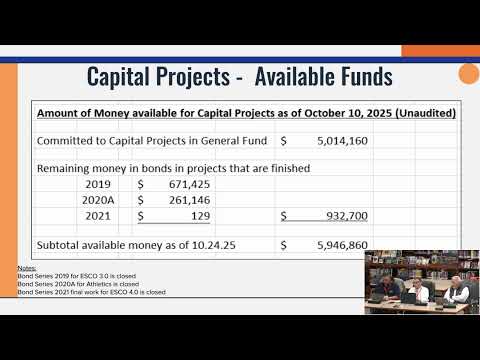
The committee discussed funding sources and the district’s cash position. Administrators said they are working with their financial advisor on bond-issue timing and with CM3 (ESCO consultant Mark Fennell) on future projects. The administration noted roughly $5,014,160 currently in the committed-to-capital-projects general-fund balance and said that completing arbitrage-rebate calculations for prior bond issues could release around $932,000 more for capital commitments, pending the district solicitor/treasurer review.
The district provided draft cost entries for many buildings and said the high school total — excluding items Fuller had just presented — was estimated at about $8,873,892, with an additional $2,000,000 listed to remove lockers and abate underlying materials if needed. Middle School East, Middle School West, elementary sites and athletic projects were also included in the top-30 list, with a combined preliminary 1–5 year total the administration presented at roughly $12–12.5 million for projects currently under consideration.
Mark Fennell of CM3 praised the district’s ongoing planning and reinvestment. “Not every district is set up as well as you are,” Fennell said, and he encouraged continuing proactive maintenance and planning to avoid larger replacement costs later.
Committee members asked the administration to: (1) identify short-term “low-hanging” projects the district could complete quickly, (2) add progress/status and estimated-completion columns to the top-30 list, and (3) continue cost-estimating work to prepare materials for a November full-board presentation. Administrators said they would follow those steps and return with refined numbers and a recommended set of priorities.