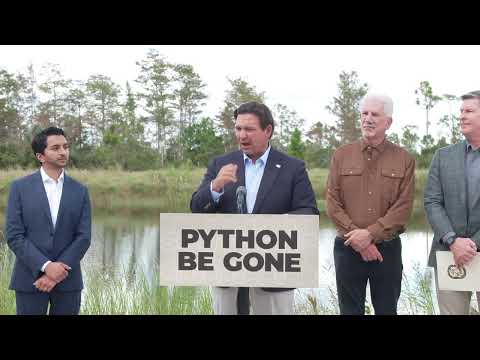
DeSantis highlights Everglades restoration milestones, credits private partner for spike in python removals
Loading...
Summary
Gov. Ron DeSantis on-site at Hungerland WMA praised state-funded Everglades work and the public‑private partnership with Inversa Leathers that officials say has sharply increased Burmese python removals and reduced agency workload.
Governor Ron DeSantis on Wednesday outlined what he called major progress on Everglades restoration and spotlighted a public‑private partnership with Inversa Leathers that officials say has sharply increased removal of invasive Burmese pythons.
DeSantis said his administration has invested heavily in restoration projects and water infrastructure and described a rapid increase in python removals since the Florida Fish and Wildlife Conservation Commission (FWC) contracted with Inversa in May. “In the first 3 months since transitioning to the program, with Inversa on May 1, FWC and Inversa have tripled the number of Python removals,” he said, noting July removals of 748 compared with 235 in July 2024.
The Everglades program context: why it matters
DeSantis framed the work as part of the state’s broader Everglades restoration effort, which he described as “the biggest environmental restoration project, in the history of the country.” He said state funding during his administration has exceeded initial promises: “We promised 2,500,000,000.0 my first 4 years. We delivered 3,300,000,000.0,” and that “we’ve done almost 8,000,000,000 for restoring Florida’s Everglades and improving Florida’s water quality during this administration.” Those figures are presented as the governor’s characterization of the state’s investments.
DeSantis listed recent project milestones named in the event: the S‑333 water control structure, removal of part of the Old Tamiami Trail roadbed, the C‑44 and C‑43 reservoirs and pump station work, and the Everglades Agricultural Area (EAA) reservoir and associated stormwater treatment areas. He said the C‑43 (Caloosahatchee) reservoir is operational and that the reservoir projects increase capacity to move and store freshwater and reduce harmful discharges to estuaries.
What officials say has changed on pythons
FWC and Inversa officials at the event described operational changes and results. Roger Young, identified in the transcript as an FWC official, thanked the governor and credited the partnership and legislative support for the program’s gains. Inversa cofounder and CEO RF Chanda said the company connects invasive‑species biomass to private markets and cited technology investments (including AI detection trials) intended to scale removals.
Officials at the event attributed the following outcomes to the partnership and recent funding:
- A reported tripling of python removals in the first three months after Inversa began working with FWC (May–July). DeSantis gave the specific July comparison (748 removals versus 235 in July 2024) and said May–July removals totaled 1,022 compared with 343 in the same period the prior year. - A stated reduction in FWC management workload that, according to remarks at the event, “is down 89,” which speakers characterized as freeing biologists to focus on science and policy work. (The transcript phrased the reduction as “down 89” without an explicit percent; speakers described it as a large reduction.) - State budget support: DeSantis said the administration secured $2,000,000 in the annual budget for FWC python removal work and called on the legislature to maintain funding. - Hunter compensation: officials said contracted python hunters are being paid roughly 60% more than before the partnership.
Officials described additional non‑regulatory changes: FWC and the Department of Environmental Protection (DEP) expanded access and authorities for python removal on certain public lands, and private landowners may remove pythons with landowner permission without a hunting license or permit, according to remarks at the event.
Quotes from event participants
“It’s the biggest environmental restoration project, in the history of the country,” DeSantis said, describing Everglades restoration. On the python partnership he said, “In the first 3 months since transitioning to the program, with Inversa on May 1, FWC and Inversa have tripled the number of Python removals.”
Inversa’s RF Chanda said the company is converting invasive biomass into leather products and pursuing technology to scale removals: “We want to improve removals by 10 x. And our investments in technology will make that happen.”
Roger Young of FWC thanked the governor and partners and said the public‑private approach has been important to recent operational gains.
What the event did not decide
No formal votes or regulatory changes were recorded in the transcript. DeSantis asked the legislature to sustain funding; event remarks described operational achievements and ambitions but did not include new statutory changes or formal commitments beyond the budget items referenced.
Why this matters locally
Speakers tied restoration work to water‑quality outcomes, tourism and wildlife protection. DeSantis noted reduced nutrient loads since 2019 and framed reservoirs and treatment areas as infrastructure that reduces harmful discharges to estuaries such as the Caloosahatchee and St. Lucie rivers. He also emphasized impacts on wildlife diversity in the Everglades and on species such as the Florida panther.
Next steps mentioned at the event included continued state funding, expanded technology‑assisted detection and removal trials, and efforts to maintain and accelerate construction and operation of reservoirs and pump stations.