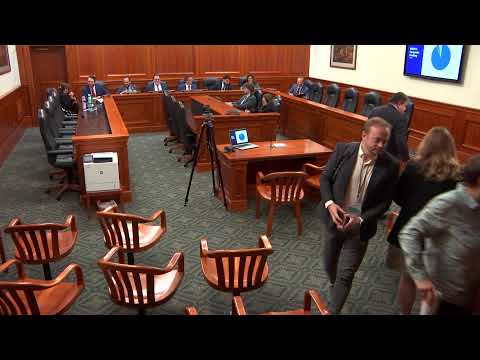
House subcommittee presses MEDC, MEDF on funding and transparency of governor-led investment missions
Loading...
Summary
The House Oversight Subcommittee on Corporate Subsidies and State Investments questioned MEDC and MEDF officials on Sept. 12, 2025, about who pays for governor-led investment missions, what details are disclosed to the public and how the two entities coordinate.
LANSING — The House Oversight Subcommittee on Corporate Subsidies and State Investments examined how Michigan’s governor-led investment missions are funded and how much the public can see about donors and trip costs during a session on Sept. 12, 2025.
Michigan Economic Development Corporation officials told the committee the trips are intended to keep and grow Michigan business and jobs by strengthening relationships with foreign investors and trading partners. “These governor led investment missions are not paid for with taxpayer dollars,” Michelle Grenell, chief communications and attractions officer for the MEDC, told the panel. Kristen Armstrong, chief operating officer and performance officer at the MEDC, described how MEDC corporate funds — principally gaming-compact revenue the MEDC receives under tribal compacts — support corporate operations and international travel.
The committee focused on two transparency lines of inquiry: the mix of funding sources that pay for missions and the Foundation’s role. Committee members pressed for clearer, more accessible disclosure of total trip costs, donor lists and which entity paid specific expenses.
Why it matters: Members said constituents are asking for clarity about public and private dollars used to support overseas trips by the governor and MEDC staff. Several members argued that even though funds are not labeled as taxes, gaming-compact revenue is public money derived from economic activity in the state and therefore deserving of public accounting.
Testimony and financial detail
Michelle Grenell and Kristen Armstrong described the missions as relationship-driven efforts that advance Michigan’s long-term economic strategy and target priority industries. Grenell and Armstrong said investment missions aim first to support firms that already operate in Michigan and to expand export and foreign-direct-investment opportunities for Michigan companies. The MEDC cited a Global Business Alliance figure that “nearly 322,000 workers here in Michigan are employed as a result of international investment,” and described cases they say resulted from mission activity, including JR Automation’s decision to locate a global headquarters in Zeeland and OP Mobility’s new North American headquarters in Troy, which the MEDC said employs more than 325 people.
On funding, Armstrong said the MEDC’s corporate budget is primarily financed by gambling-compact payments from tribal nations and by some program fees and investment returns. “The MEDC is primarily funded through casino payments,” she said, adding the corporate budget and its travel line items are approved by the MEDC executive committee in public meetings. The MEDC officials said corporate funds pay baseline travel costs such as airfare and accommodations, while the MEDF and other partners sometimes cover additional items such as photographers or interpreters. Armstrong said those decisions vary by trip and that the MEDC aims for logistics efficiency and security.
Disclosure, FOIA and public records
Members repeatedly raised that trip cost records and some participant lists have been provided to the public only after Freedom of Information Act (FOIA) requests, and questioned whether routine public reporting could be improved. MEDC staff acknowledged some trip-specific details have been redacted in publicly released documents for security reasons, but said final costs are disclosed in FOIA responses and that the MEDC has responded to more than 15 FOIA requests on this topic this year. The MEDC said it includes foundation expenditures when reporting trip totals in FOIA releases and that final reconciled costs can differ from pre-trip estimates.
Role and disclosures of the Michigan Economic Development Foundation
Eric Doster, counsel to the Michigan Economic Development Foundation, told the subcommittee the MEDF is a private 501(c)(3) nonprofit incorporated in 1984 and that it is legally separate from the MEDC. He said the foundation files an IRS Form 990 and posts an annual report and donor/board information on www.medf.org. Doster said the foundation’s 2022 Form 990 showed roughly $300,000 classified as investment mission expenses and a similar amount for conferences that year. He estimated the foundation’s annual receipts at roughly $1,000,000 but said donors and detailed line-item expenses beyond what appears on the publicly available Form 990 and annual report are not disclosed as a legal matter.
Committee members asked whether board overlaps, donor participation on trips and donor-funded travel may create conflicts or create the appearance of conflicts. Doster said the foundation has conflict-of-interest procedures and that board membership is set by the foundation’s existing directors. He emphasized the foundation does not control MEDC decisions on incentives.
Numbers and examples discussed
- MEDC corporate gaming revenues for fiscal year 2025 were presented as $65,900,000. - MEDC staff said investment mission travel in 2025 was “just under a million dollars” year-to-date. MEDF’s 2022 tax filing itemized roughly $300,000 in investment-mission expenses and about $300,000 for conferences; Doster said 2023–24 totals were similar but did not provide exact line items on the record. - The MEDC cited implementation examples it attributes to mission activity: JR Automation’s selection of Zeeland, Michigan for a global headquarters after meetings including SelectUSA and a Japan trip; OP Mobility’s opening of a North American headquarters and more than 325 employees in Troy.
Outstanding and follow-up items
Committee members requested: more granular breakdowns of trip funding showing MEDC corporate contributions versus MEDF or private contributions by trip; confirmation about whether nondisclosure agreements are in use and when; and the foundation’s conflict-of-interest policies and a comparison of MEDC and MEDF board memberships to identify any overlap. MEDC representatives said they would follow up with the requested data where available and that some items are better addressed by the foundation.
Votes at a glance
The subcommittee approved the minutes of the Sept. 17 meeting by unanimous consent. Representative Weguella moved to approve the minutes and the motion carried “without objection.”
What’s next
No final policy actions or subsidy decisions were taken at the hearing. Members indicated they expect follow-up materials from MEDC and MEDF and signaled continued interest in statutory or administrative steps to improve routine public reporting of mission costs and participants.