Get Full Government Meeting Transcripts, Videos, & Alerts Forever!
Get email alerts on the Housing Affordability topic
No spam. Unsubscribe anytime.
Charleston County updates Housing Our Future plan: tax abatement, land bank and trust fund move forward
Summary
Council committee heard progress reports on tax-abatement rules and applications, a county land-banking program managed by the Charleston Redevelopment Corporation, the Housing Our Future trust fund pipeline managed by the South Carolina Community Loan Fund, and regional zoning coordination efforts.
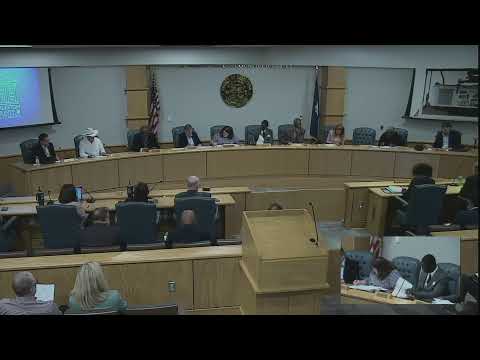
Chairman Wareman opened the special housing committee meeting to receive updates on Charleston County’s Housing Our Future plan, focusing on tax abatements, a county land bank program, a housing trust fund and coordination with municipal zoning rewrites.
The Housing Our Future plan, adopted in May 2023, sets five broad goals and 27 strategies for the whole county, county staff reminded the committee. Eric Davis, the county’s housing development director, said council has prioritized seven strategies so far and that staff would brief the committee on four of them at this meeting.
Davis summarized the county’s work to implement a uniform tax-exemption policy, adopted last year, to encourage affordable and moderate-income units in mixed-use and residential projects. Davis said staff have completed application documents and an online portal, and are finalizing ordinances and agreements, including clawback provisions and transfer mechanisms to limit “undue enrichment” of developers. He said the county has received five notices of intent, four active applications and one stalled application unrelated to the tax-abatement program. “We are still accepting applications,” Davis said, and staff plan further outreach to developers after finalizing outstanding legal documents. Davis also quoted a colleague, saying, “as my DCA, Christine Durant, likes to say, we’re blowing the plane as we fly it,” describing the implementation as iterative.
F. A. Johnson II, CEO of the Charleston Redevelopment Corporation (CRC), reported on the county-funded land acquisition program CRC administers. He said the CRC was awarded roughly $2,500,000 for acquisition and administrative costs and has closed three transactions totaling $900,000 with another $835,000 pending. Johnson said CRC’s portfolio covers a range of product types—single-family detached homes, townhouses and multifamily—and projects across the county, including North Charleston and an upcoming Mount Pleasant groundbreaking. He said preservation work at a 32-unit Ashley Phosphate Road property included parking-lot resurfacing and energy-related upgrades such as window and HVAC work intended to reduce residents’ utility costs.
Nate Barber, CEO of the South Carolina Community Loan Fund, outlined activity on the Housing Our Future trust fund that his organization manages for the county. Barber said the trust fund soft-launched in May and the loan fund received 53 initial applications (he said many were ineligible “tire-kickers”), with 37 applicants now in progress. He reported a pipeline of about $3,400,000 in trust-fund applications distributed across roughly 147 projects with a combined market value he summarized as $47,000,000. Barber said the loan fund will track applicant income levels and district location using a Salesforce-based pipeline and plans to report quarterly to the county.
Barber and CRC’s Johnson both described how program design affects the types of projects that pursue county support. County staff said the trust fund is structured for short-term, revolving loans (about five-year terms) intended to recycle capital; that design makes the trust fund better suited to workforce housing and predevelopment or short-term construction needs and less suitable for long-term financing typically required for homeownership programs. Barber said his organization is also administering a separate gap-financing program for larger-dollar, longer-term needs.
Joel Evans, the county planning director, described coordination with municipal planning efforts. He said North Charleston and the City of Charleston are both undertaking comprehensive ordinance rewrites that will span many months; county planners will participate as stakeholders. Evans noted North Charleston has amended its rules to allow accessory dwelling units (ADUs) by right in residential zoning and that it is pursuing corridors and overlay discussions where county jurisdiction overlaps municipal corridors. He said the county has “general affordable housing density incentives” in its ordinance but that those incentives have not been widely used.
Council members asked staff to clarify which portions of the affordability spectrum the county’s programs are reaching. Staff said the trust fund and many current projects target the workforce-housing band around 80–120 percent of area median income (AMI), while some tax-incentive projects under development propose deeper affordability levels. Staff said program activity so far includes rehabilitation, infill, new construction and larger multifamily projects.
Dissenting and policy comments from councilors during later discussion raised concerns about where growth and density are occurring, neighborhood fit and the potential for displacement in areas seeing new development. Evans said the county will continue workshopping design-focused alternatives for housing types and architecture so that new housing can better fit existing neighborhoods.
Staff indicated they plan to return to council with periodic reports, including a one-year status update summarizing program performance, leverage achieved, and gaps where additional tools may be needed.