Get Full Government Meeting Transcripts, Videos, & Alerts Forever!
Get email alerts on the School Closures topic
No spam. Unsubscribe anytime.
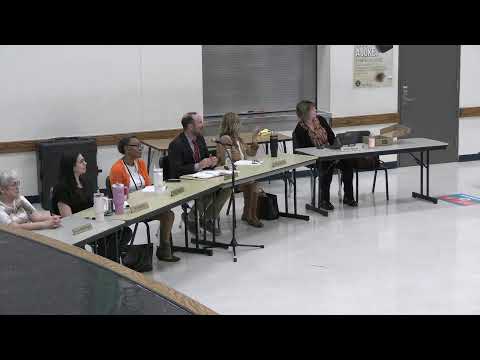
Kyrene holds first of seven public hearings on proposed school closures and boundary changes
Summary
The Kyrene Elementary School District governing board convened a public hearing at 6:00 p.m. to gather community feedback on proposed school closures, boundary changes and out‑of‑district transportation adjustments the district may vote on as early as December.
The Kyrene Elementary School District governing board convened a public hearing at 6:00 p.m. to gather community feedback on proposed school closures, boundary changes and out‑of‑district transportation adjustments the district may vote on as early as December.
The hearing followed a presentation from Superintendent Laura Tenas, who summarized recommendations developed by the district's long‑range planning committee and an independent demographer. The plan identifies elementary and middle schools proposed for closure in two phases — primarily the 2026–27 and 2027–28 school years — and a series of boundary consolidations and open‑enrollment designations intended to increase building utilization and reduce long‑term operating costs.
Why it matters: closures and redistricting would move students, change busing routes and could shift enrollment patterns that affect state funding and local housing decisions. Dozens of students, parents, teachers, school leaders and community members told the board the proposal risks breaking long‑standing school communities, increasing travel for families, and further eroding trust in the district's process.
Superintendent Laura Tenas opened the presentation by describing the planning history: a governing‑board vote launched a long‑range planning committee about a year ago; the committee made recommendations after seven months of study; those recommendations were modified following early community feedback and are now open for public comment. “Kyrene is now seeking feedback on the modified proposal, which will go to the board for a possible vote in December,” Tenas said. She added, “By consolidating resources, Kyrene aims to preserve the excellence that defines our schools and ensure fiscal stability for years to come.”
The district's published draft (as presented to speakers) proposes the following phased elementary changes: closing Colina, Estrella, Millennio and Manitas in the 2026–27 school year; closing Mariposa and Kyrene Traditional Academy (KTA) in the 2027–28 school year. Proposed boundary moves include making Lagos and Norte open‑enrollment, merging Colina and Lomas boundaries, merging Millennio and Esperanza boundaries, splitting the Estrella/Lagos super boundary between Monte Vista (east of Baseline) and Sierra (west of Baseline), and splitting KTA’s attendance area between Bridal and Paloma beginning in 2027–28. For middle schools the plan would close Ockee Mall and Pueblo in 2027–28 and reassign portions of Centennial, AltaDena and the Kyrene middle boundary areas.
The proposal also includes changes to out‑of‑district transportation: the Maricopa Region would be offered transportation to Monte Vista (elementary) in 2026–27 and Centennial (middle) in 2027–28; the district’s baseline region would continue transportation to existing receiving schools with some limitations.
Public comment was lengthy and wide‑ranging. Dozens of speakers addressed the board during two‑minute turns. Students spoke first. Kira Lee, a former Murata student and current Pueblo student, told the board, “Please don't destroy joy. Please don't split up the family. Please don't take away my second home.” Several student speakers described schools as family and pleaded to keep their campuses open.
Parents and community members repeatedly urged the board to keep Mariposa open. Nicole Gordon Trivedi, a Mariposa parent and former district student, said Mariposa is “a diverse, high‑performing neighborhood school” and warned that “any savings from closing Mariposa would be offset by increased busing costs and community disruption.” Multiple speakers cited the school’s occupancy and neighborhood draw. Speakers cited data presented earlier to the committee showing Mariposa operating around 75% capacity and serving a high share of in‑boundary students; one parent noted 66% of Mariposa's students live within its boundary and that 43% of families there are economically disadvantaged.
Other speakers asked for more transparency and consistency in the district’s process. Sang Hee Kim, a parent and public‑school administrator in another district, said district communications had promised community feedback would inform decisions but described subsequent plan changes as confusing and trust‑eroding. Alex Bradley, who advises executive teams on planning, urged the board to “pressure test” the demographer’s assumptions and produce a uniform decision framework. Several speakers asked the demographer and the district to publish the underlying numerical model and a “keep” scenario for schools the plan recommends closing.
Union and staff concerns were raised about operational impacts. Delia Leiding, president of the Kyrene Education Association, thanked the board for the outreach work but said teachers are already “stretched to our limit,” adding that operating schools below capacity increases duties on remaining staff and has contributed to departures. School staff and support employees asked for clarity about staffing and timelines if a school closes.
Multiple speakers objected to the timing and perceived selectivity of recent changes. Parents in neighborhoods whose schools were removed from the closure list said the district appeared responsive to well‑resourced or highly organized communities, while other families said changes were announced during fall break and left little time to respond. Several callers asked the board to delay implementation so current sixth graders could finish middle school at their existing campuses.
Speakers also emphasized local enrollment drivers and potential long‑term effects: loss of an A‑rated neighborhood school, family departures to charters or home districts, and the potential for nearby housing developments to bring additional families into affected boundaries. One parent noted that closing Mariposa could cost the district out‑of‑district tuition revenue if families who chose Mariposa return to their home districts.
Other substantive points raised in public comment included: the value of KTA’s traditional model and uniform policy (advocates urged consideration of preserving that model), suggestions for repurposing campuses (sixth‑grade centers, language immersion continuations or arts‑focused middle schools), and requests to preserve dual‑language access for South Mountain families who have used district transportation.
State Senator Mitzi Epstein addressed the hearing and praised Kyrene’s outreach model for regional hearings, saying, “This is an exemplary process,” and attributing the district’s fiscal pressures to state‑level funding decisions.
What the hearing did not produce: the board took no votes or formal actions at the session. Superintendent Tenas and President Walsh repeatedly reminded speakers that the hearings are for public comment and that no decisions were being made that night. The district said the earliest the board would act on a final map would be December and that any material changes to a map would require an additional, publicly noticed hearing.
Next steps and how to follow up: the district plans six additional regional hearings (one at each middle school) plus a final hearing at the district office. The superintendent advised that questions can be submitted via the long‑range planning web page and may be answered in future communications or FAQs.
The hearing record contains extensive community testimony both for and against keeping specific campuses open. The board's next public steps include additional hearings, publication of modeling details and a December board deliberation and possible vote.