Get Full Government Meeting Transcripts, Videos, & Alerts Forever!
Get email alerts on the Prejudgment Interest topic
No spam. Unsubscribe anytime.
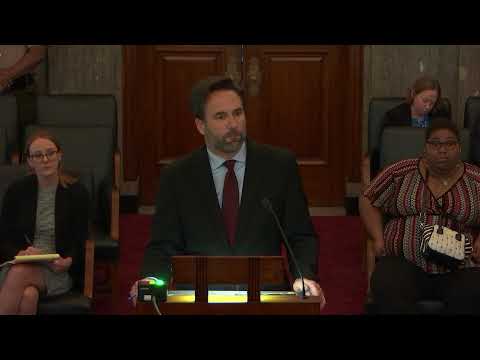
Tennessee justices hear dispute over prejudgment interest against uninsured-motorist carrier
Summary
At oral argument, lawyers and an amicus urged the Tennessee Supreme Court to decide whether prejudgment interest may be awarded as damages against an uninsured/underinsured motorist (UM/UIM) carrier under the 1979 prejudgment-interest statute, or whether longstanding precedent barring such interest in personal-injury cases controls.
The Tennessee Supreme Court heard oral argument over whether prejudgment interest can be awarded against an uninsured- or underinsured-motorist insurer that is joined in a tort suit under the state statutory scheme.
Counsel for Auto-Owners Insurance argued the court should decline the plaintiff's invitation to treat UM/UIM carriers differently from underlying tortfeasors, saying such a rule would create two classes of plaintiffs and conflict with the statute as interpreted in Wallace. "That simply doesn't make sense," counsel Connor Dugan told the court, illustrating with a hypothetical in which a tortfeasor with insurance would be treated differently than a plaintiff who recovers from an insurer that steps in under the UM/UIM statute.
The dispute centers on the 1979 codification of prejudgment interest and its interplay with the Tennessee decisions such as Wallace and later cases. Mike Campbell, appearing for Tennessee Farmers as amicus curiae in support of Auto-Owners, told the court that Tennessee Farmers v. Cherry and subsequent opinions hold that automobile liability policies "are not the type of insurance contract that would bear interest prior to any judgment secured thereon," and he argued the court of appeals overlooked that line of authority.
Plaintiff's counsel Laura Baker, representing Cinda Hadden, countered that the claim against Auto-Owners is a contract-based UM/UIM action and that the Tennessee prejudgment-interest statute (codified in 1979) makes prejudgment interest an element of compensatory damages in contract actions. "There is no dispute in this case that prejudgment interest is awardable as damages in a contract action," Baker said, arguing trial courts retain equitable discretion to award prejudgment interest after considering factors such as when the insurer should have known the claim's value.
Justices pressed both sides on practical and doctrinal questions. One justice asked whether the insurance policy itself appears in the record; Baker acknowledged the policy was not in the record but said the trial court made findings of fact and conclusions of law that the contract applied and that policy limits were $500,000. Another justice probed ripeness: when an insurer joined under the statutory scheme becomes obligated to pay and when prejudgment interest would begin to run. Baker said those timing issues are fact-specific and addressed through the trial court's equitable analysis.
Auto-Owners' counsel argued that allowing prejudgment interest against UM/UIM carriers would produce perverse incentives and inconsistent results depending on which entity ultimately pays, and he urged adherence to Wallace and related precedent. Amicus Campbell emphasized older Tennessee precedent (Tennessee Farmers v. Cherry and Cimarron Insurance) and later Court of Appeals rulings he said the lower court omitted.
Neither side asked the court to overrule Wallace outright; Baker said she was not asking the court to change Wallace as applied to individual tortfeasors but urged the court to treat UM/UIM claims as contract actions under the prejudgment-interest statute. Dugan and Campbell emphasized the risk of creating different treatment for plaintiffs based solely on which insurer pays.
The court did not issue a decision at argument. The justices recessed for the afternoon and did not announce a ruling from the bench.