Get Full Government Meeting Transcripts, Videos, & Alerts Forever!
Get email alerts on the School Policy Review topic
No spam. Unsubscribe anytime.
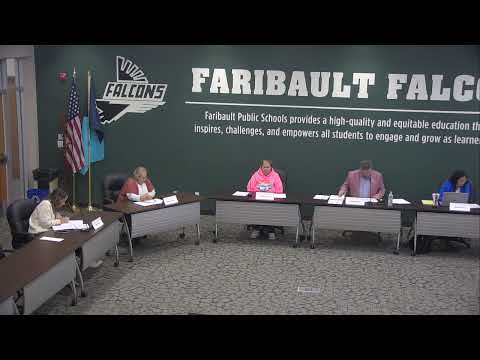
Faribault policy committee sends multiple policies to school board; member raises questions about mental‑health language and data use
Summary
At its Oct. 7 meeting the Faribault Public School District Policy Committee voted to send a package of reviewed policies to the full school board. One committee member repeatedly requested clearer definitions for references to student mental‑health services and raised concerns about how student data can be repurposed under state law.
The Faribault Public School District Policy Committee voted Tuesday to send a package of reviewed policies to the full school board, approving several motions to forward policies with no substantive edits and approving a set of legal‑reviewed revisions to one policy. The committee approved the motions after discussion; several votes were recorded 6‑1 where noted.
The matter matters because the policies govern student services, discipline and school data practices — areas that committee members said affect parental access to records, the scope of school mental‑health services and how private or confidential student data may be reused under Minnesota law.
Chair (Policy Committee) called the meeting to order and led routine votes to send policies to the board. The committee approved sending multiple policies “with no changes” including Policy 101 (legal status of the school district), Policy 103 (complaints — students, employees, parents and other persons), Policy 202 (school board officers), Policy 211 (criminal or civil action against the district, board member, employee or student), Policy 212 (school board member development), Policy 214 (board member bribery/ethics language as listed in the packet), and Policy 506 (student discipline). Most of those motions passed by voice vote; several votes were recorded as passing 6‑1.
Committee discussion focused on two items in particular. A committee member (listed in the transcript as Committee member) pressed for clearer wording in Policy 201, which in its current MSBA (Minnesota School Boards Association) model language allows the district to “provide services to promote the health of the pupils.” The committee member asked whether that language contemplates expanded mental‑health services, telehealth availability across buildings, or simply routine school nursing services. ‘‘I can’t … vote for this unless it’s defined a little bit more,’’ the Committee member said.
A staff member (Staff member) clarified that the policy text had not changed in MSBA’s model and that the policy was in the committee’s three‑year review cycle; the staff member also read a summary list of services that could fall under “promote the health,” including nursing services, emergency and chronic condition management, physical activity and nutrition, health education and community partnerships.
On Policy 506 (student discipline) the same committee member sought an amendment to specify that federal law supersedes state and local law in the policy’s statement that the district will “be aware of and comply with federal, state and local laws.” The member proposed adding the sentence “federal law supersedes state and local laws.” Chair asked for a second and the amendment failed for lack of a second. The main motion to send Policy 506 to the board then passed, recorded in the meeting as 6‑1.
The committee also spent extended time on Policy 722 (public data and data‑subject requests). The Committee member raised concerns about model language defining “individual” and about statutory provisions that allow a responsible authority to request approval for a new or different use or dissemination of private or confidential data under Minnesota law. The member said parents had previously questioned surveys and other data collection and asked whether data collected for one purpose could later be reused for another.
Chair (Policy Committee) relayed a reply from MSBA counsel on the question of withholding data: “the responsible authority determines the factors to be considered within the best interest,” and that ‘‘emotional harm may be among the factors,’’ language the chair said came from MSBA legal counsel. The committee member said that answer left them uncomfortable and worried about parental access and potential repurposing of data; the committee nonetheless voted to send Policy 722 to the board, recorded as passing 6‑1.
The committee approved sending revisions to Policy 803.4 (renumbered in the packet as 625 following legal review) to the school board. Committee materials note that legal counsel reviewed a redlined draft, removed or adjusted some language, added legal references and recommended the number change to match policy subcategories.
The committee scheduled its next meeting for Nov. 4, 2025, at 3:45 p.m. and adjourned after approving the final procedural motions.
Votes at a glance: agenda approval (voice vote, passed); send Policy 101 to board (passed); send Policy 103 to board (passed); send Policy 201 to board (passed; recorded 6‑1 in the minutes); send Policy 202 to board (passed); send Policy 211 to board (passed); send Policy 212 to board (passed); send Policy 214 to board (passed); send Policy 506 (student discipline) to board (passed 6‑1); send Policy 722 (public data) to board (passed 6‑1); send revisions to Policy 803.4 (renumbered 625) to board (passed).