Lifetime Citizen Portal Access — AI Briefings, Alerts & Unlimited Follows
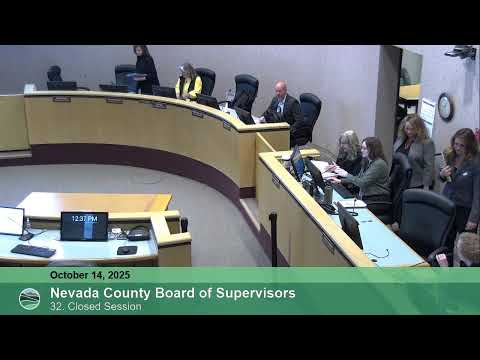
Nevada County Board adopts revised pension management policy, directs staff to produce annual funding plan
Loading...
Summary
The Nevada County Board of Supervisors on Oct. 14 adopted a revised pension management policy and directed staff to develop an annual pension funding plan and a public transparency portal. The policy sets a toolkit of options — pay-down strategies, a Section 115 trust, and other financing approaches — but does not set a firm funded-ratio target.
The Nevada County Board of Supervisors on Oct. 14 adopted a resolution approving a revised county pension management policy and asked staff to produce a one-year pension funding plan to include funding recommendations for the 2026–27 budget.
Deputy County Executive Officer and Chief Fiscal Officer Erin Mettler told the board the policy update grew from a county review begun six months earlier and a 2023–24 grand jury recommendation to revisit pension practices. “This is one of the top priorities to review all of the budget policies,” Mettler said at the meeting.
The policy update lays out a “toolkit” of options the county will consider annually as part of the budget process, including making incremental additional payments to reduce unfunded liabilities, establishing and operating a Section 115 pension trust, and reviewing refinancing options. Andrew Flynn of California Municipal Advisors, retained to assist the county, described the approach as “a spectrum question” that blends short‑term cash‑flow choices with long‑term cost mitigation. “These liabilities don’t disappear,” Flynn said. “This is a long‑term process.”
Why it matters: Nevada County’s pension plans are materially underfunded compared with actuarial targets. Mettler said the county’s funded ratio was about 63.7% as of CalPERS’ 2023 report and that the county’s unfunded accrued liability (UAL) measured roughly $273.9 million in principal with approximately $175.8 million in interest baked into current amortization schedules (figures reported from CalPERS reporting and consultant analysis). Flynn and Mettler told the board that recent positive CalPERS investment returns are expected to reduce the shortfall in upcoming actuarial reports, but that market cycles mean the county must plan proactively for volatility.
What the policy does and does not do: The revised policy established (a) a formal process for annual review and reporting, (b) continued use of the Section 115 trust the county already maintains, and (c) staff direction to prepare a one‑year plan with specific funding recommendations for incorporation into the fiscal 2026–27 budget. The policy addendum is intended as a working document to guide staff recommendations. The board specifically declined to set a fixed funded‑ratio target in the policy itself; Mettler said the administration will return with a plan before the board commits to any numerical target.
Board discussion and concerns: Supervisors pressed staff on specifics — including why the policy does not set an 85% target that some earlier drafts had suggested — and on the tradeoffs between using reserves for capital projects versus putting those funds toward pension obligations. Mettler said the administration favored first producing a detailed funding plan before committing to an aspirational target. Flynn emphasized the benefit of small, regular additional contributions over large, one‑time measures and noted that pension obligation bonds (a refinancing measure some jurisdictions use) were not recommended for Nevada County in the current interest‑rate environment.
Action and next steps: The board voted unanimously to adopt the resolution. The resolution directs staff to (1) post pension reports and a transparency portal on the county website, (2) develop an annual pension funding plan to be considered with the FY 2026–27 budget, and (3) report back with additional payment recommendations if the county’s financial picture permits. The board roll call recorded five yes votes: District 5 — yes; District 2 — yes; District 4 — yes; District 3 — yes; District 1 — yes.
The administration said the debt advisory committee (treasurer‑tax collector, auditor‑controller and CFO) will work with consultants to bring a detailed annual plan to the board for consideration before the next budget cycle. The policy and addendum (attached as exhibits to the adopted resolution) serve as the county’s framework for these ongoing annual decisions.
Ending: County staff will present the initial annual pension funding plan and populate a public transparency portal with actuarial reports, funding options and staff recommendations as part of the FY 2026–27 budget process.