
CPED recommends $115.3 million general-fund budget for 2026; mayor’s plan shifts some rental supports into school-based program
Get AI-powered insights, summaries, and transcripts
Subscribe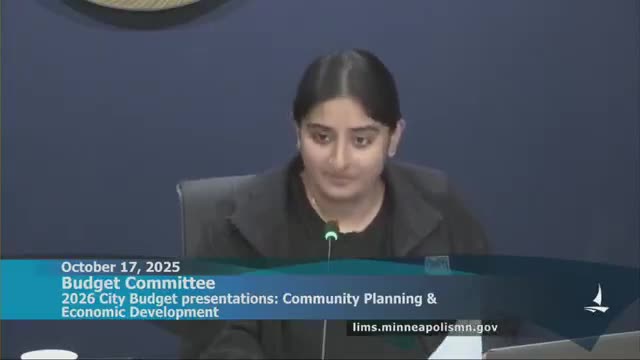
Summary
Community Planning and Economic Development Director Eric Hansen presented the department’s recommended 2026 budget to the Budget Committee on Oct. 17, proposing a $115.3 million general-fund budget with targeted reductions and one-time additions to sustain housing production and stabilize shelter and school-linked housing supports.
Community Planning and Economic Development Director Eric Hansen presented the department’s recommended 2026 budget to the Minneapolis City Council Budget Committee on Oct. 17, proposing a $115,300,000 general-funded operating budget and a mix of reductions and one-time additions aimed at preserving housing production and stabilizing existing programs.
Hansen told the committee, “We’re proud to present the CPED’s 2026 supplemental budget recommendations,” and outlined a package that includes roughly $3.5 million in ongoing general-fund reductions and about $11.5 million in mostly non-general-fund additions for 2026.
The budget focuses on four divisions — housing policy and development; economic policy and development; development services; and planning — and reduces the department’s full-time equivalent (FTE) headcount from 243 to 238. Hansen said about 67 CPED positions are at least partly funded by federal sources.
Why it matters: CPED stewards the city’s housing, development and small-business programs. Changes to funding streams and program design affect housing production, shelter capacity and services to small businesses and entrepreneurs across Minneapolis.
Key program changes and numbers
- Affordable housing and trust fund: Hansen recommended a one-time Local Affordable Housing Aid (LAHA) allocation to sustain housing production. The presentation lists a $7,350,000 LAHA allocation dedicated to the Affordable Housing Trust Fund as part of a broader $17,000,000 recommended trust fund budget for 2026. The $7.35 million represents a mix of the new local sales tax (LAHA) and TIF set-asides, Hansen said.
- Stable Homes, Stable Schools: The recommended budget shifts funding from emergency housing vouchers toward Stable Homes, Stable Schools. Hansen said the shift will support “over 260 families” participating in Minneapolis Public Schools, representing about 770 children in those households. Hansen and staff told the committee the program will face a fiscal cliff in the second quarter of next year without additional funding.
- Emergency Housing Vouchers (EHV): The mayor’s recommended 2026 budget shifts $1,400,000 previously identified for EHV into Stable Homes, Stable Schools. Council members raised concerns that EHV and Stable Homes, Stable Schools serve distinct populations: Hennepin County and CPED staff said many people who qualify for EHV would not be eligible for the school-linked program. Hansen said the mayor’s recommendation uses EHV dollars to shore up the school-linked program’s near-term shortfall.
- One-time and targeted additions: Among other one-time items in the presentation, CPED recommended: - $7.35 million (LAHA) to the Affordable Housing Trust Fund - $1 million LAHA to emergency shelter response (to flow through a joint powers agreement with Hennepin County) - about $1,000,000 one-time to Minneapolis Homes - $240,000 from the downtown assets fund for property maintenance at the Kohl Center - $100,000 general fund for People’s Way property maintenance while community planning continues - $350,000 one-time for the Development Technical Assistance Program (DTAP)
- Program reductions in the proposed package included a $1,400,000 reduction tied to EHV, an $810,000 reduction to a senior housing code abatement program (CPED said those services would be consolidated into Minneapolis Homes rehab activities), a $500,000 reduction to the adult workforce tech-hire program, and smaller reductions in food-and-beverage operating costs and two budgeted positions (about $210,000). Hansen described the choices as tradeoffs intended to preserve core housing and economic priorities.
Council questions and clarifications
- Stable Homes vs. EHV populations: Council Member Wansley sought to clarify whether the Stable Homes, Stable Schools program serves the same population as EHV. Hansen and housing director Alfred Port told the committee Stable Homes, Stable Schools serves primarily families with elementary students in Minneapolis Public Schools, while EHV is targeted at people who are experiencing homelessness more broadly. In response to a direct question, Port said Stable Homes, Stable Schools “is available to about 95% of the families that have elementary students in the Minneapolis public school system,” but also stated that many people who would receive EHV would not be eligible for the school-linked program.
- Emergency shelter funding mechanism: When asked whether the proposed $1,000,000 one-time allocation for emergency shelter response would be distributed by contract or RFP, Port said those dollars would be contracted through the city’s joint powers agreement (JPA) with Hennepin County. Port said the county envisions using the funding to extend winter-warming shelter beds in 2026 and estimated the award would support about 150 beds during that period; selection of shelter sites would follow the county’s process.
- Business and small-business pilots: Council members pressed CPED for status updates on several small-business and loan pilots added in previous budgets. Hansen said one pilot — a loan program for businesses impacted by construction — has not yet been written and that CPED will provide program status updates via email and follow-up memos. He said underwriting and public-purpose review are part of program design and that new programs typically take six to nine months to stand up.
Other program notes
- Ownership and Opportunity Fund & 2% loan program: Hansen said the Ownership and Opportunity Fund has helped 27 businesses with about $13,600,000 since 2020, and the city’s 2% loan program provided roughly $2,100,000 to support 35 businesses last year. CPED is proposing to scale some of these resources as one-time allocations for 2026.
- Minneapolis Homes and rehabilitation: CPED highlighted Minneapolis Homes outcomes — 103 households became homeowners through city programs in 2024, and 123 households received critical home repairs since 2022, averaging about $47,000 per project. Hansen said Minneapolis has one of the largest racial homeownership gaps in the nation and that Minneapolis Homes is part of the city’s effort to reduce that disparity.
What remains unsettled
Council members repeatedly asked for clarifying memos and data: specifically, (1) a breakdown of LAHA distributions and timing (how LAHA disbursements intersect with the city’s budget calendar); (2) data on seniors served through the senior abatement program and Minneapolis Homes rehab program (2022–2024); (3) status updates on small-business pilots and the $900,000 forgivable/repair loan pilot for businesses impacted by construction; and (4) details on how the city and county will operationalize the $1,000,000 shelter allocation.
No formal votes were recorded at the Oct. 17 presentation. CPED staff said they would return with follow-up materials and that a separate council action will be required to move certain funding decisions (for example, redirecting funds to stabilize Stable Homes, Stable Schools).