Kyrene CFO reviews bond, override spending and publishes annual budget report
Loading...
Summary
Chief Financial Officer Chris Sherman presented the district's annual update on voter‑approved bonds and overrides, summarizing $31–34 million in recent capital expenditures, the use of maintenance and operations override funding to support staffing and student services, and the publication of Kyrene's detailed budget annual report.
Chief Financial Officer Chris Sherman presented the Kyrene Elementary District governing board with the district's statutorily required annual report on bond and override expenditures on Oct. 14 and introduced the district's budget annual report, an ASBO‑aligned document summarizing revenues, expenses and capital planning.
Sherman walked the board through how transportation and capital funding are calculated and distinguished bonds from maintenance and operations (M&O) and District Additional Assistance (DAA, the capital override). He explained that transportation funding is calculated using a "transportation support limit" based on miles driven and noted that although the state increases its per‑mile rate periodically, the district's annual transportation revenue often remains constant because of statutory testing rules tied to the support limit.
On capital spending, Sherman reported that the district spent roughly $31–34 million on capital projects in fiscal 2024–25 across three categories cited in the bond pamphlet: maintaining schools (about two‑thirds of the total), transportation (bus and vehicle purchases), and administrative campus projects. Within the maintaining‑schools category, construction projects made up roughly 80% of that sub‑total, covering roofing, HVAC, playgrounds and related site work across multiple campuses. Technology and classroom furniture replacement were also identified and quantified.
Sherman explained how the M&O override — which the district will seek to renew on an upcoming ballot — funds teacher salaries, class‑size reduction, additional electives and specialized student supports such as speech, occupational and physical therapy. He said the district's M&O override contributed roughly $14.8 million in 2024–25, an amount Sherman equated to the salaries and benefits of about 200 teaching positions and roughly 25% of the district's teaching staff in terms of funding equivalence. He and board members discussed that loss of override funding would require multi‑year reductions and that the district typically plans for renewals a year in advance to avoid sudden budget cliffs.
Sherman also summarized the DAA (capital override) spending, which he said prioritizes instructional technology, software licensing, and network infrastructure; instructional technology accounted for the largest DAA category in 2024–25. He noted that Kyrene maintains a 10‑year capital master plan to prioritize projects and that bond proceeds must be spent consistent with voter pamphlet descriptions.
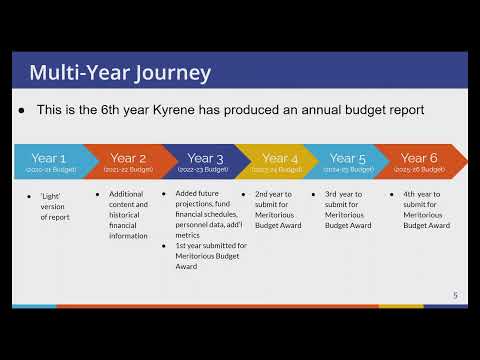
Sherman highlighted Kyrene's long‑standing transparency practices: annual audits, public budget workshops, an online budget report that earned ASBO International's Meritorious Budget Award in recent years, and the district's historically high credit ratings from Moody's and Standard & Poor's. He encouraged community members to consult the published budget annual report for detailed line‑by‑line revenue and expenditure information.
Board members asked clarifying questions about whether override‑funded student supports replace special‑education obligations (Sherman and the district director of student services said M&O funds allow the district to provide services beyond state minima and to reduce staff caseloads but do not remove federally required special‑education obligations), and about the district's administrative cost ratios (Sherman said Kyrene's administrative costs are lower than the state average and that Kyrene places a high share of budget dollars in classrooms).
Sherman closed by noting the district would submit the 2025‑26 budget annual report to ASBO International for award consideration and reiterated that all detailed financial records are available online and through the Auditor General and other public reporting channels.