
Becker County to end paid care-coordination contracts with UCare and Medica, reassign staff to mandated work
Get AI-powered insights, summaries, and transcripts
Subscribe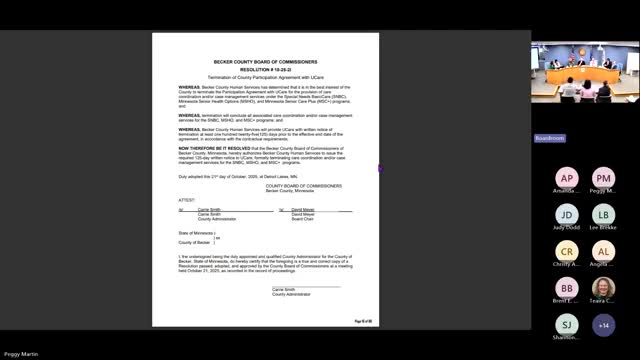
Summary
Becker County commissioners approved ending contracted care-coordination work for UCare and Medica and reallocating affected staff to mandated human services functions after projected 2026 revenues fall short of costs.
Becker County commissioners voted to terminate the county’s care-coordination contracts with private plans UCare and Medica and to reassign staff currently performing that work to mandated county services.
County Human Services staff told the board the county currently provides care coordination for roughly 392 UCare members and about 115 Medica members. Projections for 2026 from the plans show membership and contract revenue falling; after updating revenue expectations, Human Services reported a projected shortfall of about $79,000 for the 4.5 full-time-equivalent positions that perform care coordination.
Human Services Director Denise (Human Services) and public-health and adult-services supervisors presented the analysis. They said care coordination is not a statutory county duty and that health plans and private vendors will continue to provide care coordination services for members, but county staff now face rising mandated workloads — including increased MNChoices assessments, new Community First Service and Supports (CFSS) follow-ups, and other disability-waiver oversight. Those activities are funded, the department said, and require additional case-management capacity.
The department proposed ending the county’s UCare and Medica contracts and reassigning the 4.5 FTEs to meet mandated duties. Officials estimated that reassigning those positions and shifting revenue to funded mandated work would move the program from a projected $79,000 deficit to an approximate $200,000 surplus compared with the status quo, without increasing the Human Services budget overall.
Commissioners discussed timing and transition. The motions recorded in the meeting referenced a 125-day notice period in the contracts; commissioners approved the resolutions to end the contracts and to realign staff duties. During the public discussion portion of the presentation, commissioners and staff stressed that recipients will continue to receive care coordination through the plans or other contractors, and that the county’s case managers will be reassigned to meet the growing mandated workload and compliance requirements.
The board approved the pair of resolutions authorizing the contract terminations and the staff reassignments, noting that department managers will implement the staff transitions within the notice period and that the county will monitor how other vendors and the plans provide continuing care coordination to local members.
The action responds to both a falling revenue forecast tied to plan product changes for 2026 and to state-level program changes that increase county case-management responsibilities. Staff said additional state reporting and potential new performance measures will also increase county workload in 2026.