Get Full Government Meeting Transcripts, Videos, & Alerts Forever!
Get email alerts on the Water And Sewer Rates topic
No spam. Unsubscribe anytime.
San Fernando council adopts water, sewer rate schedule after Prop. 218 hearing; protests fall short
Summary
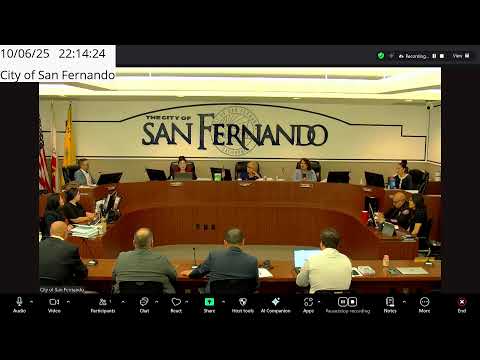
After a weeks‑long Prop. 218 process and a public hearing with nearly 480 written protests, the San Fernando City Council approved a five‑year water and sewer rate schedule that will take effect January 2026. Council recorded a 3‑1 vote with one member absent.
The San Fernando City Council voted 3‑1 on Oct. 6 to adopt a resolution setting new water and sewer rates following a Proposition 218 majority protest hearing; the city clerk reported 479 written protests, fewer than the 2,630 needed to block the increase. The rates are projected to fund roughly $1 million a year in capital investments and to rebuild reserves for aging infrastructure.
The council opened the hearing after consultants and staff described a cost‑of‑service analysis used to allocate operating and capital costs to customers. Consultant Anthony Olofsky said the study recommended annual adjustments of up to 5% per year over a five‑year cycle to pay for pipeline replacements, treatment plant work and reserve increases to guard against inflation and emergency repairs. “We are projecting about $1,000,000 per year in investments in the water and sewer utilities,” Olofsky said during the presentation.
Olofsky said the study also added a “pass‑through” charge that would apply only if the city must purchase Metropolitan Water District (MWD) supplies rather than rely on its groundwater wells. He explained that 100 cubic feet equals 748 gallons and walked council members through the bill impacts for a typical residential customer using about 2,100 cubic feet bimonthly.
City finance director Erica Melton and interim public works director Bill Evans answered council questions about project types and the consequences of not approving the increases. Melton said using general‑fund dollars to cover enterprise fund shortfalls would be limited by law and would reduce funds available for other deferred capital projects. Evans said aging pipes and recent main breaks show the need to move from reactive to more proactive repairs: “You have 55‑plus‑year‑old pipe… it’s only a matter of time before you have a significant amount of breaks in those areas.”
Business owner Kenny Majors, speaking during public testimony, said he had submitted a written protest and criticized prior rate adjustments and the city’s communication about past increases. “It is very misleading when the city states they haven't raised [rates] since 02/2019,” Majors said, adding the financial pressure on small enterprises.
After the public comment portion closed, the city clerk reported a final count of 479 protests and zero formal objections. Councilmember Patty Lopez voted no on the resolution; Councilmember Victoria Garcia was absent from the vote. Councilmember Joe Fajardo, Vice Mayor Mary Salodio and Mayor Mary Mendoza voted yes. The mayor closed the public hearing and the council approved the rate schedule; staff said the new rates will be implemented in January 2026 unless council later amends the schedule.
The city manager and public works staff said they will prepare a prioritized capital improvement plan and return with project phasing, grant reimbursement schedules and further detail on which specific pipes and treatment components will be addressed first. Staff noted some water and treatment work already has grant funding and that timely project delivery matters because construction inflation has increased the cost of repairs.
Council members asked staff to return with a public‑facing project list showing how rate revenues will be spent and to provide advance notice to customers if and when MWD water must be used and passed through on bills. Staff recommended and council accepted a 30‑day notice practice for switching supplies.
The adoption resolves the Prop. 218 process after the required public notice period and hearing; the council recorded a roll‑call vote that resulted in three yes, one no and one member absent. The approved resolution instructs staff to implement the adopted rates and to bring follow‑up reporting as the projects move into design and construction.