
Enrollment rises, building space strains and federal shutdown monitored, Duluth superintendent says
Get AI-powered insights, summaries, and transcripts
Subscribe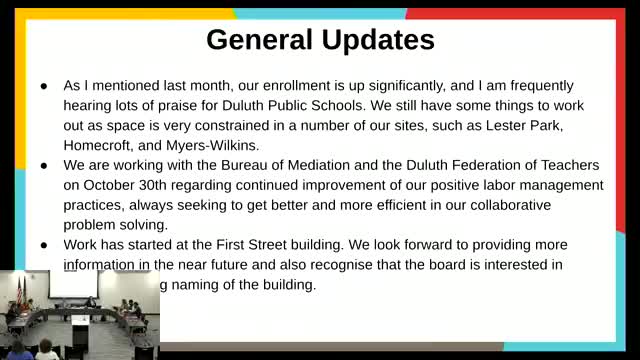
Summary
Superintendent John Magus reported enrollment above budget, constrained space at several elementary sites, HR transitions, plans for the First Street building and continued monitoring of the federal government shutdown at the October Duluth School Board meeting.
Superintendent John Magus told the Duluth School Board at its October business meeting that district enrollment is higher than budgeted, that several elementary schools are at or near capacity, and that the district is monitoring potential impacts from the federal government shutdown.
Magus said the district budgeted 8,099 students for the school year and reported current enrollment of 8,254.59. He said Homecroft and Lester Park elementaries are “out of room” and that Homecroft is using a teachers’ lounge as classroom space; Myers-Wilkins and other sites also face capacity constraints. Magus said the district will review demographic studies to determine next steps and possible capital planning responses.
Magus also provided an update on human resources. He said Teresa Severance’s last day was Oct. 10 and that he is serving as interim director of human resources while the district reviews applicants for the permanent role. Magus announced that Steven Johnson has started as the district’s new human resources manager.
On labor relations, Magus said the district is scheduling a Bureau of Mediation training session with the Duluth Federation of Teachers for Oct. 30 focused on improving collaborative labor-management practices rather than mediating a specific dispute. He described it as “continuous improvement” work to deepen problem solving.
Magus outlined plans for the district’s new First Street building, including ongoing construction and an intention to undertake a naming process before the building opens; he said a formal naming process takes several months and encouraged the board to consider next steps.
On federal budget disruption, Magus said the district has not yet seen “significant” operational impacts because many federal programs’ funds were already distributed or are held in reserve. Director Crane said approximately $2,800,000 in federal special-education funds were allotted to the district in July, so current special-education programming remains funded. District staff cautioned that the broader shutdown effects—such as furloughed family members and interruptions in food assistance programs—could have indirect effects on students.
Magus also discussed the district’s legislative timeline: he and lobbyist Jeff Anderson plan to present a draft legislative platform at the November workshop and aim to finalize and vote on a platform in December so local representatives can be briefed in January before the session.
Board members asked for follow-up on specific site capacity data and cited Policy 810 (naming rights and naming school facilities) as relevant to the First Street building. Magus said administration will follow up with details and indicated willingness to arrange board tours of the First Street site when feasible.