
Treasurer warns tax reform and state funding shifts could cut millions; board adopts five-year forecast
Get AI-powered insights, summaries, and transcripts
Subscribe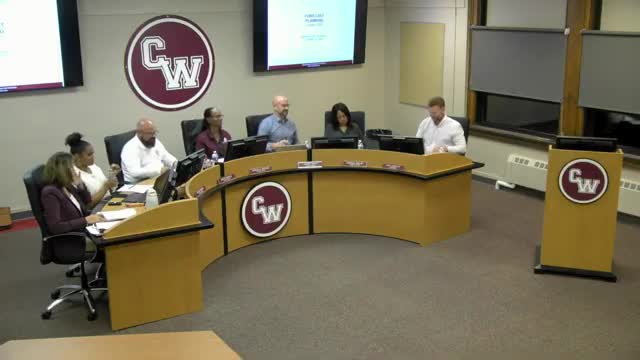
Summary
Treasurer Roberts told the Canal Winchester Local board that state funding changes and proposed tax legislation (House Bill 186) and the potential loss of the district—s emergency levy would sharply reduce revenue over the five-year forecast; the board approved the forecast by roll call.
Treasurer Roberts presented a revised five-year forecast at the Oct. 13 Canal Winchester Local School District board meeting and warned that pending state legislation and reappraisal-driven local capacity growth could reduce state and local revenues by millions.
Roberts said the district has moved from being on the state funding formula to being on the 2020 guarantee because of enrollment, local capacity and unchanged base costs. He told the board that if the base cost is not adjusted, local property-value growth will push districts back toward a 2020 guarantee and reduce state aid per pupil. "If they were not to change the base cost in the next biennium budget...the state share would go from $3,600 to $2,200 and 29 per pupil. So it's a $1,400 decline," he said.
Roberts also laid out two scenarios in his forecast: one assuming no legislative changes to property-tax collections and the other showing the impact of House Bill 186 and the elimination of the district—s emergency levy. "House Bill 186 crushes a lot of districts," Roberts said, arguing the bill would retroactively reduce local revenue and also suppress future growth in property-tax collections that otherwise feed local and state funding calculations. In the worst-case illustration, Roberts said the district—s cash balance would decline into negative territory within the forecast window absent replacement levies or policy changes.
Roberts described the emergency levy as a key near-term revenue source and said removal of the renewal would eliminate nearly half of the district—s emergency-levy receipts in a subsequent year. He gave example figures showing multi-million-dollar hits tied to retroactive valuation adjustments and changes to how the state counts local capacity.
Board members and staff discussed advocacy and next steps. Roberts said he had sent proposals to the Ohio House and Senate and planned to meet with lawmakers to present the forecast and potential policy fixes, including annual reappraisals or updates tied to inflation and counting emergency levies toward the 20-mill floor. He said those changes would blunt large single-year spikes that have driven recent proposed reforms.
The board voted to approve the five-year forecast in a roll-call vote during the meeting; the forecast filed with the Ohio Department of Education will reflect the board—s direction. Roberts said he will continue outreach to legislators and expects the district to consider fiscal options, including but not limited to levy planning, if the legislation moves forward.
Ending
Treasurer Roberts urged continued community engagement with state lawmakers and said the district—s next steps include filing the forecast, continuing legislative outreach and preparing potential fiscal adjustments should House Bill 186 or similar measures advance.