Get Full Government Meeting Transcripts, Videos, & Alerts Forever!
Get email alerts on the Public Safety topic
No spam. Unsubscribe anytime.
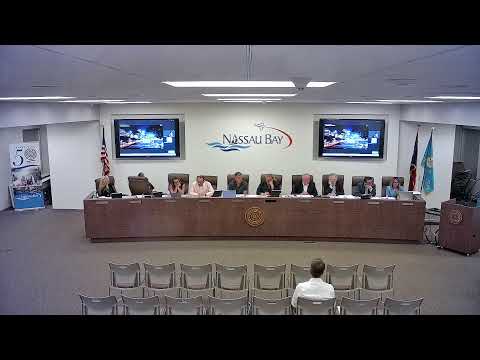
Nassau Bay council hears vendor proposals for park security cameras; questions on cost, poles and waterways
Summary
At its Oct. 20 meeting the Nassau Bay City Council heard two vendor presentations on a pilot to add video cameras at city parks and waterways. Vendors and staff discussed costs, solar-powered poles, warranty and a prospective Nov. 1 price increase; council did not take a final procurement vote.
Nassau Bay City Council on Oct. 20 heard two vendor briefings on a proposed pilot to add live and recorded cameras at city parks and along waterways, including cost estimates for pan-tilt-zoom (PTZ) and fixed cameras, options for solar-powered poles and questions about whether CenterPoint utility poles can be used.
The presentations — one update on the pilot budget and a second virtual presentation from Flock Safety — laid out per-camera prices, installation and warranty terms and operational details such as cellular data and night-time, AI-powered alerts. Council members and staff discussed adding cameras at the finger piers and over the cove and raised concerns about unapproved private installations on utility poles.
Why it matters: Council members said the cameras respond to recurring vandalism and public-safety concerns in parks and on city property. Staff and vendors described hardware, recurring costs and options that affect the city budget and the timing for a decision.
What vendors and staff told the council - An update on the existing pilot budget: staff reported an original budget of about $65,000 that grew in scope because of added PTZ cameras; the larger scope figure discussed in the meeting was $89,856. Staff also cited a per-camera monthly warranty/management figure of $44.52 as part of a three-year estimate (presented as part of the vendor update).
- Flock Safety (presenter Seamus Ford) proposed a partly solar, cellular (LTE) deployment that would avoid relying on utility-company poles. Flock’s pricing in the slide deck shown to council listed unit prices of $3,250 for a fixed live video camera and $4,000 for a dual‑lens PTZ camera. In the plan shown to council, six fixed cameras and three PTZ cameras produced a first‑year total of $31,500; Flock’s slide said installation and permitting would be included and that the company would perform site surveys to confirm solar viability under tree canopies. Flock recommended a 12‑month contract term initially to allow deployment adjustments.
- Flock described operational features: AI-powered “guardian” alerts during designated overnight hours (for example, 11 p.m.–5 a.m.), evergreen hardware upgrades (the vendor replaces units with new versions as they become available), remote diagnostics and a replacement/repair policy included in the subscription. Seamus Ford said the company would not offer or enable facial recognition: “We will never do that,” he said.
- Council members asked whether cameras could be placed to monitor waterways and the Cove; Ford said waterways could be added and would be scoped separately. Council members and staff also noted a citizen-installed camera on a CenterPoint pole; both vendors and staff said CenterPoint typically does not permit vendor installations on its poles, so proposed deployments rely on vendor-owned poles and solar power.
Questions about price increases and timing - One vendor representative (Alex, speaking after the pilot update) told council the vendor was preparing for a market price increase tied to tariffs and inflation and that a November 1 effective date was expected; the representative said the likely order‑of‑magnitude increase under discussion was roughly in the single digits (“we've heard anywhere from 10% to maybe 7%,” he said). Council members flagged the timing as a reason to move quickly if council wished to lock current pricing.
Operational and technical notes - Flock demonstrated PTZ zoom capability using live footage from an existing deployment, and staff described license‑plate legibility ranges the vendor cited (vendor materials said plates can be read reliably at roughly 800–1,000 feet under favorable conditions). Flock and staff said cameras use embedded LTE service (Verizon/AT&T/FirstNet or carrier with best coverage) and that the vendor performs site surveys for trees and shading before installation.
- Chief of Police told the council that Flock/related camera systems can often be diagnosed or recalibrated remotely; the chief described a recent incident in which staff “were able to go into the camera remotely ... and fix that issue” without a vendor site visit.
No final procurement vote - The council discussion ended without a formal vote to approve purchase or to amend the currently funded pilot. Staff and vendors were asked to provide additional pricing and scope detail for cameras at finger piers and on the water, and council members discussed whether to authorize staff to proceed or return with a recommendation.
Ending - Staff said they would continue to scope locations and work with vendors on a formal proposal; vendors warned of an expected price-change window around Nov. 1. Council did not approve procurement at the Oct. 20 meeting.