Get Full Government Meeting Transcripts, Videos, & Alerts Forever!
Get email alerts on the Monitoring Report R4 topic
No spam. Unsubscribe anytime.
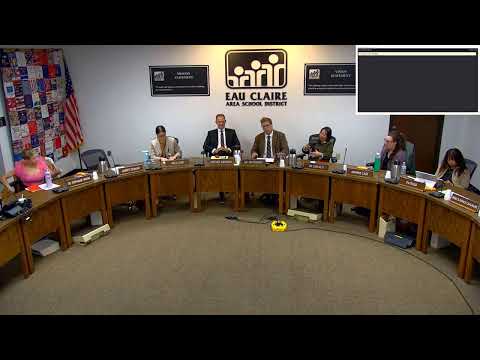
Board approves R4 monitoring report showing gains in student climate; commissioners press for deeper disaggregated data
Summary
The Eau Claire Area School District board approved its R4 monitoring report ("Citizens of a Diverse Community") after administration presented multi-year indicators showing modest improvements in student climate and social-emotional measures. Several commissioners urged stronger disaggregation by race, income and disability status and called for a
Eau Claire, Wis.
The Eau Claire Area School District board voted Oct. 20 to approve its monitoring report for R4, "Citizens of a Diverse Community," after Executive Director Van Vliet presented five-year trends and new pre/post measures tied to the district''s school-counseling curriculum.
Administrators said for the first time all six R4 policy indicators show "reasonable progress," pointing to gains on student climate survey items and in counseling-assessed competencies. Van Vliet reported increased elementary-level measures of students who say they get along with others (from about 81.5% to 83.5%) and secondary improvements in measures of cross-background interaction. The presentation also noted a 14-point increase in elementary students demonstrating ethical decision-making skills on a new school-counseling pre/post assessment (from 61% to 75%).
Board members commended the district''s work but said the district must do more to disaggregate results and accelerate improvement for the most affected groups. Commissioner Zerr and others pressed the administration on disparities in disciplinary removals and climate perceptions for Black students, students with disabilities and economically disadvantaged students. "When they're sitting 20 to 25 points behind their white peers ... it's hard for me to stomach the word 'reasonable,'" Zerr said.
Administrators acknowledged continued gaps and identified next steps that include implementing a Portrait of a Graduate (beginning 2026-27) to replace the current "behaviors of lifelong learners" measures, developing essential standards assessments in ELA, civics and social studies for 2026-27, and refining tier 2 and tier 3 supports for students needing extra behavioral and social-emotional help.
Commissioners also discussed the Youth Risk Behavior Survey (YRBS) and other national datasets used as benchmarking tools. Van Vliet said district leaders will continue to build additional indicators so the system is less dependent on any single external survey.
The motion to approve the R4 monitoring report was moved by Commissioner Beka and seconded by Commissioner Farrar; the board recorded unanimous approval by voice vote. Several commissioners asked that future monitoring presentations include more disaggregated, curriculum-linked evidence so the board can better evaluate equitable outcomes across student groups.