Get Full Government Meeting Transcripts, Videos, & Alerts Forever!
Get email alerts on the Minimum Wage topic
No spam. Unsubscribe anytime.
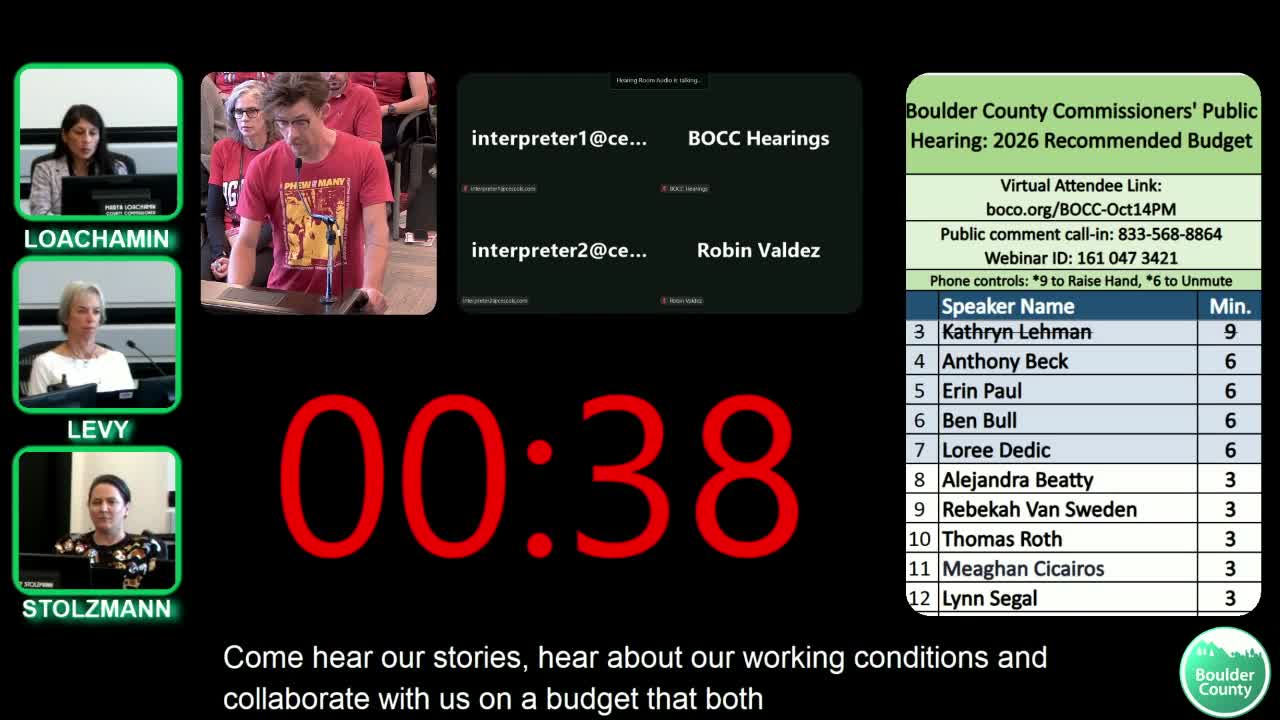
Boulder County reopens local minimum wage debate; commissioners consider pausing or aligning schedule
Summary
After months of public input, Boulder County commissioners reopened debate on the county’s local minimum wage schedule. Staff presented five options including pausing the 2026 increase and aligning the county schedule with the City of Boulder; farmers, small-business owners and worker advocates delivered conflicting testimony.
Boulder County commissioners held a public hearing Oct. 14 on potential amendments to County Ordinance 2023-4, the local minimum wage schedule that phases county unincorporated-area wages to $25 an hour by 2030. Staff presented five possible paths: pause the 2026 increase and convene municipalities for a regional approach; pause until county wages align with the lowest municipal wage; hold 2026 wages steady and apply the state‑level CPI in later years; accelerate alignment with the City of Boulder; or reduce the 2026 increase and then apply CPI.
Mark Rosen and Nick Robles of the commissioners’ policy team summarized the local process required under HB 19‑1210 (state legislation that permits local minimum wages), stakeholder outreach from 2022–23, and the rationale for reopening the schedule given a wave of recent public comments. Staff reported receiving more than 1,200 online responses and more than 100 minutes of public testimony in the prior month and said the most common concern was the impact on small businesses in unincorporated towns.
Family resource center representatives told commissioners that county residents increasingly rely on rent and food assistance. “We’re meeting about 25% of the community need right now,” Mark Howell of the Auer Center said, summarizing rental assistance demand and food‑bank distribution trends.
Speakers split broadly into three camps:
- Worker-advocacy groups and unions urged the county to keep the current schedule and continue wage increases tied to inflation, arguing that higher wages are needed to meet living costs and would circulate in the local economy. Cece Bloomfield, a volunteer and local food-systems advocate, said small farms provide food security and should be protected by broader policy choices while still urging living wages for workers.
- Farmers, many of whom said they already pay above minimum wage, and small-business owners in Niwot and other unincorporated towns urged a slower schedule or alignment with the City of Boulder to avoid competitive disadvantages against neighboring municipalities and larger markets. Farmer Michael Moss said produce farming is highly labor intensive and that “labor costs make up 50 to 55% of our total revenue,” arguing a sudden leap in local labor costs could force farms and small sellers to close or be priced out.
- Local business owners in unincorporated towns — including grocers, cafes and other small retailers — urged either a pause in 2026 increases or a regional approach so unincorporated business districts do not face a wage cost disadvantage compared with adjacent towns.
Staff clarified that state law prohibits local governments from carving out specific industries (for example, a farming exemption) under HB 19‑1210, and that compliance and enforcement of local minimum wages is managed by the Colorado Department of Labor and Employment. Staff also noted county staff had offered a small-business grant program at the time the ordinance was adopted; that grant program has since been eliminated in the county’s 2026 budget planning.
Commissioners asked follow-up questions about stakeholder outreach and enforcement. After public testimony, the board voted to table the matter for further deliberation and directed staff to return for additional discussion at a business meeting on Oct. 21, 2025, before any first-reading motion would be scheduled for Nov. 20 as required by statute.
Why it matters: The ordinance affects only unincorporated Boulder County and not municipalities; because several nearby cities have not adopted matching schedules, the county’s earlier decision to set a relatively high path to $25 by 2030 left unincorporated businesses calling for a pause or alignment to avoid competitive pressure.
What’s next: Commissioners directed staff to return on Oct. 21 for further deliberation and to advertise any proposed amendments for the required first and second readings prior to a final vote. Written comments remain open as described by staff.