Get Full Government Meeting Transcripts, Videos, & Alerts Forever!
Get email alerts on the General Plan topic
No spam. Unsubscribe anytime.
Cottonwood Heights leaders revive long‑stalled general plan, form subcommittees and set adoption targets
Summary
City council and planning commissioners paused work on a consultant draft of the general plan, agreed to use the 2005 vision as a starting point, created chapter subcommittees, and set an aspirational July 1, 2026 adoption target while flagging a state deadline for a required water element before year’s end.
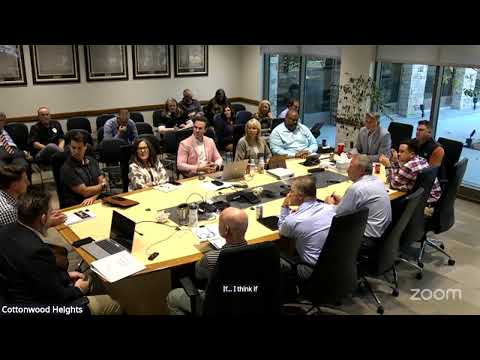
Mayor Mike Quakers and members of the Cottonwood Heights City Council and Planning Commission on Oct. 21 agreed to pause work on a recent consultant draft of the city's general plan, use the 2005 vision statement as a framing device, and organize subcommittees to rewrite chapter-level mission statements and short goal lists.
The move follows months of feedback from commissioners and council members that the consultant's draft read as boilerplate and did not sufficiently reflect local priorities. "I think one of the areas of the general plan that's interesting ... is we don't have a great understanding of what we actually accomplished from the 2005 general plan," Planning Commissioner Sean Steinman said during the meeting, urging the group to inventory past achievements before drafting new goals.
Why it matters: the general plan guides land‑use expectations for developers, informs zoning and code changes, and sets long‑range priorities for transportation, parks and recreation, housing and utilities. Council and commission members said they want a document that clarifies what the city will seek from landowners and developers rather than a broad, non‑specific statement.
The council and commission agreed on several procedural steps. They asked subcommittees to return with (a) a concise mission statement for their chapter, (b) three to five prioritized goals tied to implementable actions, and (c) a review of older, adopted master plans and technical studies to decide which should be carried forward, updated or retired. Mayor Quakers called the update a priority going forward and proposed an aspirational adoption date of July 1, 2026. The mayor also warned that the city's water element is subject to a state requirement and may need separate adoption before the end of this calendar year to avoid a compliance issue.
At the start of the work session, Council staff noted two agenda items scheduled for the evening's business meeting: an ordinance amendment to allow a catering service in an ORD zone and changes to open‑air accessory structure setbacks, and a consulting agreement with a firm for the regular compensation study. Those items were previewed but not debated in substance during the session reported here.
How the plan will be reworked
Participants generally favored keeping the 2005 vision wording as a starting point while removing language that some said was interpreted as prescriptive. Council member Suzanne Hyland read aloud the 2005 statement: "Cottonwood Heights is a community that highly values its history of a well maintained residential community. The preservation of quality of life is of utmost importance to residents and business owners." Hyland and others said the phrasing had been used in past land‑use disputes to argue against nearly any change.
Commissioners and council members proposed parsing the material into separate vision, mission and values statements so the plan is both aspirational and actionable. "This can be parsed out into those different statements," Planning Commissioner Sean Steinman said, describing values as the city's priorities, the mission as "what we are gonna do," and the vision as the desired future state.
Members repeatedly urged that subcommittees ground recommendations in past work and in adopted technical plans (transportation master plan, Fort Union Boulevard plan, parks and trails plans, storm drainage master plan, and similar studies). Council member Burrell emphasized that the city already has many adopted master plans and studies that should be referenced and not discarded.
Subcommittee structure and next steps
Council and commission members agreed to form topic subcommittees aligned to the general plan elements the state requires and to local priorities: land use, transportation, housing, water (a state‑required element), and economic development/fiscal health, with recreation and open space treated as an element integrated with land use and parks plans. Members volunteered to serve on the committees during the meeting; staff will circulate a written roster.
The meeting yielded these operational decisions and deadlines: - Subcommittees should produce a draft mission statement and three to five prioritized goals for their chapter and identify relevant adopted master plans that should inform the update. - The group set an aspirational citywide adoption date of July 1, 2026, to allow time for outreach and ordinance alignment. - The city acknowledged a specific state requirement: the water element may have to be adopted before the end of 2025; staff and consultants will work to meet that separate deadline. - The council planned a progress check during the city's first December meeting (the calendar date discussed was the Dec. 2 business meeting) so staff can bring forward any elements that must be adopted sooner for state compliance.
Consultant and regional coordination
City staff and the mayor invited the project consultant and a Wasatch Front Regional Council (WFRC) representative to participate in the discussion. WFRC's Christy Dalberg told the group that coordination with neighboring cities is a common and recommended practice, particularly for regional thoroughfares and for facilities that cross jurisdictional boundaries.
Public‑facing emphasis and next steps
Speakers urged the plan to acknowledge Cottonwood Heights' role as a gateway community to nearby canyons and ski areas and to treat tourism and visitor economy opportunities as part of the plan's economic development strategy, while protecting livability in residential neighborhoods. Several members suggested language that recognizes the city's mountain‑suburban character while also allowing strategic, geographically targeted growth in specific nodes (for example, the gravel pit redevelopment area, Fort Union town center and commuter corridors).
Mayor Quakers asked staff to circulate a memo summarizing assignments and timelines and to coordinate meeting times for the subcommittees. Commission and council volunteers were asked to begin drafting mission statements and to return with recommendations at the December check‑in.
Ending
The work session ended with calendar reminders and logistics for upcoming public events. No formal ordinance or resolution votes were taken during the work session portion of the meeting reported here; the council moved to adjourn the joint work session portion and proceed to the business meeting agenda.