Get Full Government Meeting Transcripts, Videos, & Alerts Forever!
Get email alerts on the Property Tax topic
No spam. Unsubscribe anytime.
Skagit County assessor briefs Sedro-Woolley council on value changes, senior tax-exemption outreach
Summary
Skagit County Assessor Danny Hagan told the Sedro-Woolley City Council the county has completed a reinspection cycle that shows roughly 7% assessed-value increases across the school district and outlined outreach and senior/disabled exemption changes and the county's use of street-view imagery for inspections.
Skagit County Assessor Danny Hagan told the Sedro-Woolley City Council on Tuesday that reinspection work and market shifts have pushed assessed values up in the county, and he urged the city to help spread word about state property-tax exemptions for seniors and people with disabilities.
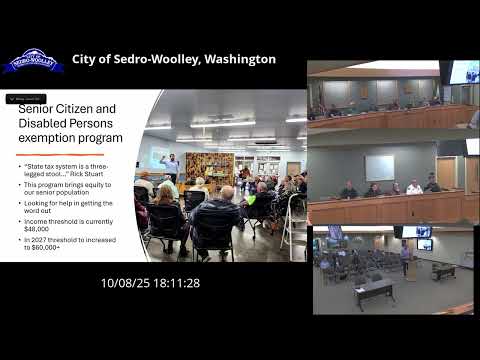
Hagan said countywide assessed values for the Cedar Woolley school district rose about 7% in the current reinspection cycle, with an approximate 6% increase inside the city limits. He described the county's reinspection process, the use of street-view imagery to reduce visits to private property and an outreach push for the senior and disabled-persons property-tax exemption.
The assessment changes matter because they affect the distribution of existing property-tax levies and can change individual bills even where levy rates do not rise. Hagan said the reinspection is intended to align assessed values with market conditions and to catch unpermitted changes or errors in property records.
Hagan described how the county completed a desk-and-imagery reinspection across the Cedar Woolley School District, which includes roughly 16,742 residential parcels and about 1,200 commercial/industrial parcels. He said the assessor's office used eight residential appraisers and two commercial appraisers for the cycle and that inspectors now rely more on current aerial, oblique and street-view imagery rather than routine door-to-door walks. "If we can verify a parcel is unchanged from imagery, we make that a brief inspection and respect the homeowner's privacy," Hagan said.
He also highlighted the Washington senior- and disabled-persons property-tax exemption. Under the program, an owner-occupant who lives in the home at least six months a year and who meets age or disability and income rules may qualify for an exemption. Hagan told the council the state's Office of Financial Management numbers indicate the income threshold used in the program will be reset in 2027 and that current projections put the new threshold near $65,000, which would expand eligibility. Hagan said medical deductions can reduce the income calculation for applicants and that the assessor's office offers an online portal and community presentations to help residents apply.
Council members pressed Hagan about the program's complexity, the timing of the 2027 threshold reset and how rising residential values have shifted the tax burden. Hagan said the 2027 threshold is set by a state formula tied to county median income and that office guidance will be clear by March of the next review year. He also noted that residential values have grown faster than some commercial segments over the past two decades, which shifts more of a budget-based tax burden to homeowners even when levy rates fall.
Hagan recommended city outreach, including links on the municipal website and presentations at senior centers. Council members asked staff to explore putting a notice or link about the exemption on utility bills and other customer-facing materials.
The presentation closed with Hagan offering to return for a work session if the council wanted a deeper dive on reinspection methods or the senior-exemption application process.