Get Full Government Meeting Transcripts, Videos, & Alerts Forever!
Get email alerts on the Transitional Housing topic
No spam. Unsubscribe anytime.
Hearing examiner to decide on Family Promise plan for 14 transitional homes on Sedro-Woolley church property
Summary
The City of Sedro-Woolley held a hearing Aug. 12 on a conditional use permit for 14 modular transitional housing units on roughly 1 of 2.9 acres owned by Central United Methodist Church. City staff recommended conditions; neighbors raised concerns about trees, parking, safety and property values. The hearing examiner will issue a written decision.
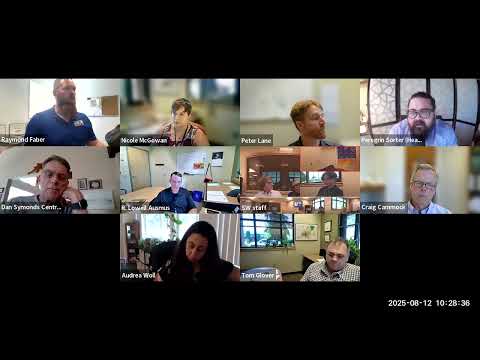
City of Sedro-Woolley hearing examiner Peregrine Sorter opened a land‑use hearing Aug. 12, 2025, on a conditional use permit application from Family Promise of Skagit seeking to place 14 transitional housing units on about 1 acre of a 2.9‑acre parcel owned by Central United Methodist Church at 1013 Pulte Road in Sedro‑Woolley.
The permit application would use the density provisions of RCW 36.70A.545 to allow more units than the R‑7 zone’s typical seven‑units‑per‑acre maximum. City planner Nicole McGowan told the examiner the city has not yet adopted local code language setting a cap under that state statute; staff recommended conditions to address site design, infrastructure, landscaping, fire and life safety, operations and ongoing compliance. The hearing examiner said he would issue a written decision within 10 business days.
Staff described the proposal as 14 prefabricated but modular homes on permanent foundations, each self‑contained with a private kitchen, bathroom and in‑unit washer and dryer; unit sizes range from about 400 to 898 square feet. The site plan shows pedestrian pathways, a shared open area and landscapes. Family Promise proposes cooperative parking agreements so residents use portions of the Central United Methodist Church parking area and the adjacent Bethlehem Lutheran Church lot; staff said minor improvements to the church lot would be required to ensure emergency access.
Nicole McGowan said the city issued a Mitigated Determination of Nonsignificance (MDNS) under the State Environmental Policy Act for the proposal and that the MDNS was not appealed. She said staff reviewed zoning, design and environmental standards and routed the proposal to reviewing agencies; staff recommended conditions including compliance with the most recent Washington State Department of Ecology stormwater manual.
City engineer Peter Lane told the examiner that water service is provided by the local public utility district (PUD) and that the city’s sewer system has capacity at the plant and in mains and laterals to serve the development. He said a new fire hydrant would be required by the PUD and the fire department.
Family Promise Executive Director Adria Wall said the organization serves families with children and that the transitional units would house families who have completed the shelter program. "We serve families with children, not just women with children," Wall said. Attorney Craig Cammock advised that RCW 36.70A.545 and federal anti‑discrimination law allow Family Promise to set occupancy criteria limiting the program to families with children and that excluding single adults without children is a permissible program requirement.
Contractor Raymond Faber described the units as modular (not HUD trailers or mobile homes) built in a local factory and placed on foundations. "These are not HUD homes. These are not mobile homes. They're modular homes," Faber said. He said the site layout was painted on the ground and that large trees shown on the plan are intended to remain; he added a formal survey is still to be completed.
Neighbors who spoke at the hearing and on Zoom raised multiple concerns: the number of trees to be removed, the type and permanence of the prefabricated units, impacts to property values, existing trash and parked vehicles on adjacent church lots, child safety near a playground and traffic through parking areas, security and enforcement of program rules, and the adequacy of fencing and screening between homes and adjoining yards. Public commenters included David Mullins, Richard Jackson, Wendy Granberg, Judy Haugness and Judy Lemley. Several commenters said they had sought police reports and disputed statements they heard at earlier community meetings about the volume and nature of police calls at the church sites.
Church trustee Dan Symonds said the Central United Methodist property had been surveyed in the past during a prior subdivision and that the church has hired a new surveyor to establish current lines and easements; he also said some neighbors had recently extended fences onto church land. Adria Wall said Family Promise uses case management and program graduation as part of vetting for transitional housing, will add on‑site cameras, add a site operations manager and a dedicated case manager for the development and will work with neighbors on landscaping and fencing once a survey and final plans are complete. Wall said Family Promise would consider relocating seasonal shelter operations that draw additional calls and traffic once the transitional units are in place.
City planner McGowan reiterated that staff viewed the proposal as closer to a multifamily development for recreation/open‑space standards and that staff found the site compatible with surrounding uses, subject to the recommended conditions. The hearing examiner closed testimony and said he expects to issue a written decision within 10 business days; members of the public may request a copy in writing or by email.
The hearing was a procedural evidentiary proceeding; no final permit decision was made at the hearing. The record includes the staff report, application materials, draft lease and easement agreements, environmental review materials, public comments and the exhibits admitted at the hearing.