Get Full Government Meeting Transcripts, Videos, & Alerts Forever!
Get email alerts on the Human Services Funding topic
No spam. Unsubscribe anytime.
Sedro‑Woolley council backs consolidated funding process; agrees to split capital and service rounds and to issue service RFPs this fall
Summary
Sedro‑Woolley council members backed a consolidated application process for several human‑services funding streams and voted to split capital and service cycles so service awards can be made in time for winter; staff was directed to issue a service RFP this fall.
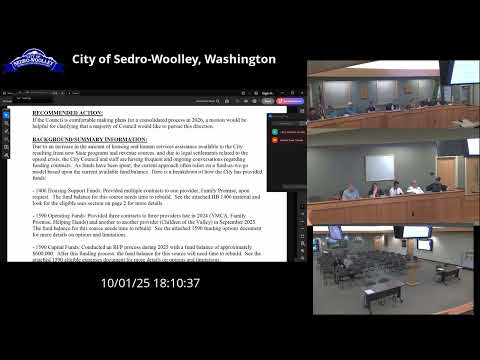
Sedro‑Woolley city staff proposed consolidating multiple human‑services funding streams — 1590 operating, 1590 capital, 1406 and opioid settlement funds — into a single, simplified application process. Council members expressed broad support for consolidation while asking staff to separate capital and service rounds so service awards can be made in time for winter needs.
Charlie (city staff) said the City’s packet included current fund balances and that the One Washington memorandum of understanding requires a public funding process for opioid settlement funds. Staff proposed a single application that would allow applicants to check which funding sources they were seeking, with additional capital questions for those applying for 1590 capital. Charlie recommended aiming for a consolidated annual cycle, with a possible split that would run capital in spring and services in fall.
Council members, police and fire chiefs and others discussed eligible uses for opioid settlement funds under the One Washington MOU, including canine units, Narcan, prevention programming and support for a mobile integrated health‑care (MIH) position that both fire and police said they have struggled to staff. Fire and police chiefs noted some opioid uses are limited by the MOU but that the county’s Northstar program could take 80% of the city’s current opioid pool while the city retains 20% for local priorities.
Budget figures discussed in the meeting included a spreadsheet line for opioid funds that a staff member read as about $206,334 in the packet; the council discussed the practical implication that 80% of that sum would be approximately $80,000 to be directed to Northstar and 20% roughly $20,000 retained for other local purposes (staff noted some settlement payments arrive on multi‑year schedules and annual totals will vary).
After discussion, the council voted to split the funding cycles (capital in spring, service RFP in fall) and directed staff to issue a consolidated service funding RFP this fall that would include 1406 and 1590 operating money and allow applicants to check opioid funding eligibility where applicable. Council members said they want flexibility to allocate existing operating funds this winter to providers with immediate needs (several council members urged issuing service awards soon so winter shelter and vouchers can be planned).
Public comment: Dan Simons, a volunteer with Family Promise, urged the council to consider that funding bricks‑and‑mortar housing developments targeted at 60% area median income (AMI) can leave out lower‑income households and may reduce funding available for emergency shelter and 30% AMI needs.
Next steps: staff will prepare a consolidated RFP template, seek input from partners (including Northstar and county staff) on opioid‑eligible uses, and return to council with a proposed timeline and projected fund balances for capital and operating cycles.