Get Full Government Meeting Transcripts, Videos, & Alerts Forever!
Get email alerts on the Comprehensive Plan Climate Element topic
No spam. Unsubscribe anytime.
West Richland reviews regional draft climate element; public comment open through Oct. 8
Summary
West Richland city planning staff and consultants reviewed a draft Tri‑Cities regional climate element on Sept. 9 that the city must incorporate into its comprehensive plan under state law; the draft is posted for public comment through Oct. 8 on the BFCOG website.
WEST RICHLAND, Wash. — West Richland city planning staff and consultants reviewed a draft regional climate element on Sept. 9 that the city must incorporate into its comprehensive plan under state law, and invited public comment through Oct. 8.
The draft, prepared by Cascadia Consulting Group and Burke Consulting for a Tri‑Cities/Benton County regional effort, contains a resilience subelement addressing climate‑exacerbated hazards (wildfire, heat, drought and flooding) and a greenhouse‑gas (GHG) emissions‑reduction subelement. Eric (city staff) told the group, “Again, this is a state requirement, so we're not really here to debate whether or not climate change exists.” The draft is posted on the Benton‑Franklin Council of Governments (BFCOG) website for public comment.
The document is intended to meet requirements added to the Growth Management Act by House Bill 1181 (2023). Consultants said the GHG subelement for West Richland identifies on‑road passenger vehicles and off‑road equipment as the city’s largest emissions sources and recommends policies addressing transportation, buildings/energy and waste. The consultants’ presentation also summarized a vehicle‑miles‑traveled (VMT) projection presented to commissioners, which they said would increase roughly 15% by 2045 in the city’s analysis.
Why it matters
House Bill 1181 requires cities and counties undergoing comprehensive plan updates to include both climate resilience and emissions‑reduction policies. West Richland must adopt the relevant subelements as part of its periodic comprehensive plan update; the draft schedules a regional handoff of materials at the end of October and lists adoption in the city’s periodic update package (adoption date shown in the draft materials as December 2026).
What presenters said
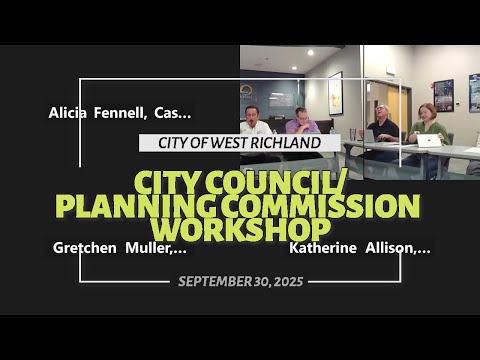
Gretchen Mueller, identified as a director at Cascadia Consulting Group and the project manager for the Tri‑Cities regional climate element, outlined the deliverables consultants completed for the draft: a tree‑canopy assessment, a climate impact summary, a climate vulnerability assessment and a GHG inventory with projections and a VMT analysis. Catherine Allison and Alicia Fennel of Cascadia presented technical findings and draft goals and policies.
Cascadia said the draft pairs two required subelements: a resilience subelement that must (1) address natural hazards exacerbated by climate change, (2) identify and protect natural areas, and (3) identify and strengthen community resilience; and a greenhouse‑gas subelement that must (1) reduce overall GHG emissions without shifting emissions elsewhere in the state, (2) reduce per‑capita VMT, and (3) prioritize reductions that benefit overburdened communities. The consultants said the draft frames policies and goals to work toward a net‑zero emissions target presented in the materials.
Public comment and concerns raised
Meeting participants asked questions and raised concerns that the consultants and staff noted for follow‑up: - Ozone and air‑quality scope: A commenter identified as Greg asked whether ozone is included in the analyses. Consultants said their GHG inventory uses CO2e (carbon‑dioxide equivalent) and includes carbon dioxide, methane and nitrous oxide; they said they would check whether ozone‑specific impacts are included and report back. - Data sources and methods: Several participants asked where supporting datasets and technical appendices are located; consultants pointed to appendices and the BFCOG posting and offered to circulate datasets and methodology appendices on request. - Floodplain mapping and housing impacts: Participants raised that FEMA is updating floodplain maps for the Yakima River and that any expansion of mapped floodplain could affect housing and insurance requirements. Staff said floodplain mapping and levee certification are county processes and that public comment periods exist for those FEMA updates. - Implementation and specificity of goals: Commissioners asked whether the draft goals will be SMART (specific, measurable, achievable, relevant, timely). Consultants said the regional draft intentionally keeps goals higher level and that jurisdictions will refine, prioritize and set measurable implementation actions during their local comprehensive plan updates. Staff noted the Department of Commerce requires jurisdictions to track progress toward adopted goals every five years. - Local feasibility: Commissioners and staff questioned some proposed policies from the citizen advisory team as impractical for West Richland (example cited: installing misters at transit stops), and discussed the tension between expanding tree canopy and conserving water in a desert climate; staff said they are coordinating with the Benton Conservation District to identify low‑water vegetation strategies.
Next steps and how to comment
Consultants said the draft has been posted for public review on the BFCOG website and the public comment window runs through Oct. 8. The consultant team will finalize the regional element and provide an implementation “handoff” package to each jurisdiction by Oct. 31; local jurisdictions will integrate the regional element into their comprehensive plan updates. Staff requested that local commissioners share any comments they submit online with planning staff to ensure regional coordination.
No formal votes or ordinances were taken during the meeting; the session was a technical briefing and public Q&A on the draft climate element.
Ending
Consultants closed by repeating the public comment deadline and offering to circulate datasets and CPAT (climate policy advisory team) affiliation lists on request. Staff said they will review comments, work with Burke Consulting (the city’s periodic‑update consultant) on integration, and bring tailored, jurisdiction‑specific policy recommendations back during the comprehensive plan update process.
Quotes used in this article are taken directly from the meeting transcript and attributed to speakers listed in the meeting record.