
Wichita County indigent health office reports large spending reductions, credits stricter eligibility and community partnerships
Get AI-powered insights, summaries, and transcripts
Subscribe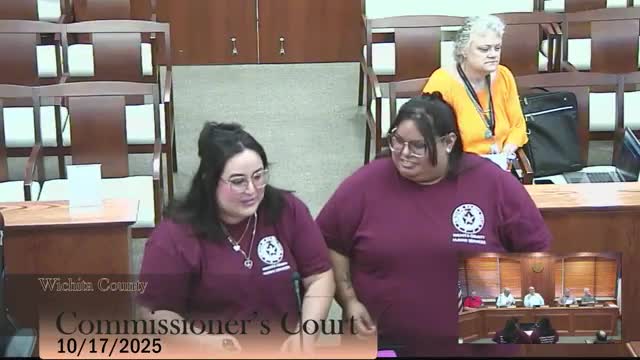
Summary
At an Oct. 17 Wichita County Commissioners Court meeting, indigent health care staff reported a drop in county spending on indigent care since 2018 and described program changes, community partnerships and prescription-management steps they say produced savings while keeping services for active clients.
Wichita County — At the Wichita County Commissioners Court meeting on Oct. 17, 2025, staff from the county’s indigent health care office reported that county expenditures for indigent health services have fallen substantially since 2018 and described steps they say produced the savings.
The office told commissioners that county payments for indigent health care declined from about $1,300,000 in 2018 to $572,000 in 2024 — a drop the presenter characterized as roughly a 58% reduction. Pharmaceutical spending was reported to have fallen most dramatically: staff said pharmacy costs decreased from $601,247 (2018) to about $70,000 in 2024, a reduction the office described as about 88.35%. Optional services spending (dental, orthopedics, vision and other nonprimary care services) was presented as falling from $241,170.13 in 2018 to $56,351.69 in 2024, a 77.6% reduction. The office said the county currently has about 90 active clients and five “I A pended” clients — those awaiting a Social Security decision.
The presenter attributed the reductions to a combination of stricter eligibility and case-management procedures, expanded outreach and new partnerships with local providers and prescription-assistance programs. "We stepped out — boots on the ground — and met with our community partners," the presenter said, describing outreach that staff said produced a visible spike in client contacts in early April 2024 followed by a stabilized caseload. The office said it requires clients to reapply every six months "by statute" and holds payment on bills while Social Security appeals are pending; staff said it does not authorize specialist care or prescriptions for I A pended clients until a Social Security determination is received.
Staff described several programmatic changes and community arrangements they said reduced cost while keeping needed services available. Those included lowering the per-script authorization cap (from a model the presenter described as allowing a maximum of $1,500 per script times three to $500 times three), more active review of claims to avoid paying for unused durable medical equipment (the presenter said the office stopped paying for some CPAP subscriptions that were not in use), and closer coordination with pharmacists and hospitals to secure manufacturer assistance, samples or prescription-assistance programs. "We've learned from the pharmacy that they could actually reach out to the vendor itself and get those scripts either for free or on a program to be mailed out," the presenter said.
Staff also described partnerships with community organizations and vendors to reduce specific costs. The office reported using St. Vincent de Paul, GoodRx and other prescription-assistance programs and said it arranged a partnership with America's Best to obtain eye exams and glasses at no cost for many clients; staff said each client using that service saved the county roughly $134.72 in office-visit costs and that the program saved the county $1,700 in 2025 to date and a total of $22,963.84 across their accounted activities. For county burial and cremation services the presenter reported current spending at about $15,000 and projected total spending this year of $25,000–$30,000; the office said it is seeking donations when families choose that option and attempting to recoup available funds where estates or insurance exist, reporting reimbursements already recovered in the current year and additional small amounts pending paperwork.
The presenter described a community outreach strategy the office said it runs to connect potential clients with services: the office aims for about 30 outreach events per year and reported three to four events per month in 2025 so far. Staff said outreach sites have included the housing authority, food banks, churches, the transition clinic and United Regional. The office said it also holds a "lunch and learn" for providers to explain the county's billing process and points of contact for questions.
County commissioners and other meeting participants asked clarifying questions about client counts, whether clients classified as homeless are being served, and how prior enrollment practices had inflated historical counts. The presenter said predecessor practices included not requiring reapplication every six months and at times listing jail inmates as active clients, and that tightening those practices reduced the active caseload from several hundred to the current level. When asked how many clients identify as homeless, the presenter said most active clients are connected through the Salvation Army, the Mission and Faith Refuge and estimated that roughly three-quarters of their active clients come through those providers.
The presenter said the office will attend the Texas Association conference (identified in the presentation as TICA) next week to follow new legislative developments in indigent health care and noted other upcoming local outreach events. Commissioners asked for the office’s PowerPoint slides for posting and said they expected to discuss the results at a town hall.
The presentation did not include any formal motions or votes. Commissioners commended the office for the changes described and for maintaining access to primary and preventive care while reducing county expenditures.