Get Full Government Meeting Transcripts, Videos, & Alerts Forever!
Get email alerts on the Transportation Streets Lighting topic
No spam. Unsubscribe anytime.
Council hears changes to street‑lighting approach and scheduling for major intersections
Summary
Staff proposed removing city‑owned decorative street lighting from most reconstruction projects in 2026, keeping it selectively for gateway corridors such as Bowen Street, and described timing coordination with the Wisconsin Department of Transportation for the Oshkosh–Sawyer intersection.
At an Oct. 15 workshop, City of Oshkosh staff told councilmembers they intend to remove city‑owned decorative street lighting from most street reconstruction projects in 2026 and instead rely on utility‑owned cobra‑head lighting where poles are owned by utilities such as Wisconsin Public Service and AT&T. Staff said the change is intended to reduce capital costs and focus city‑owned lighting on select corridors and gateways—Bowen Street was cited as an example where city‑owned lighting would remain because design work is advanced and it functions as an entry gateway.
Staff also discussed the Ashish Avenue–Sawyer Street intersection project. The city has budgeted preliminary funds across 2026–27, totaling about $1 million, for land acquisition and final design; staff said two parcels remain to acquire to allow construction to proceed when Tax Increment Financing district (TIF 35) funding is available. The city is coordinating timing with planned Wisconsin Department of Transportation pavement and bridge maintenance projects around 2032; staff said if DOT work and the city’s schedule align, it may make sense to perform the intersection work while state crews close the corridor to avoid repeated closures.
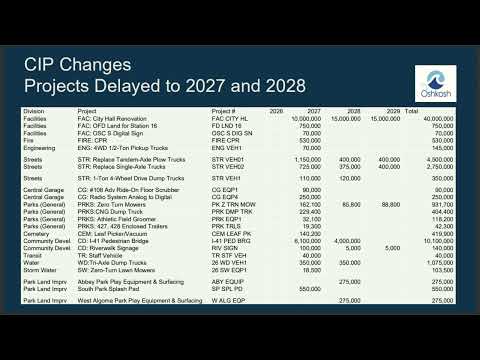
Other street‑related notes included reduced CIP estimates after staff re‑reviewed bids and construction‑cost trends and that some traffic signal improvements (Ohio Street and South Park Avenue) still require work.
Ending: Staff said the changes aim to be strategic about where the city invests in decorative, city‑owned infrastructure and to coordinate construction timing with state projects to minimize repeated closures; council asked for continued updates on land acquisition and design completion for the Ashish–Sawyer intersection.