
CPS facilities report shows $61M roofing need; district lays out five‑year capital priorities
Get AI-powered insights, summaries, and transcripts
Subscribe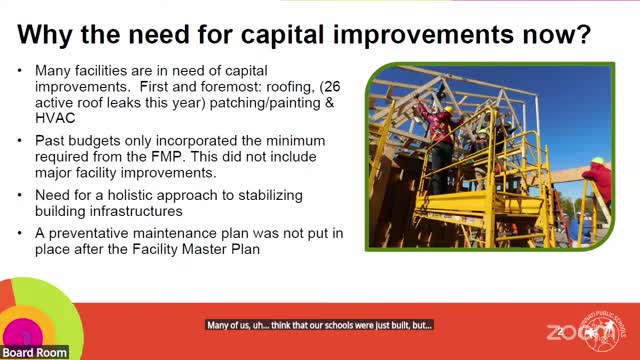
Summary
Cincinnati Public Schools staff presented a five‑year facilities master plan at the Oct. 11 retreat identifying major maintenance and capital costs — roofs ($61M), painting ($30M), HVAC ($20M), cameras and athletic field upgrades — and urged planning for rising maintenance needs.
Cincinnati — Cincinnati Public Schools presented a five‑year facilities plan Oct. 11 that catalogs deferred maintenance and upgrades across the district and places roofs, painting, HVAC and camera replacement among the largest upcoming capital needs.
Chief facilities staff briefed the board on a multi‑year project list and a template that spreads tasks across fiscal years. The plan groups work in categories such as roofs, HVAC, playgrounds, cameras, athletic fields, carpets and fire‑alarm upgrades and assigns estimated costs and target life cycles for replacement.
Key figures and priorities: The presentation included these approximate district needs: $61 million for roofing replacements, $30 million for painting, $20 million for HVAC replacements, roughly $15 million for carpeting and about $4 million to replace or upgrade cameras at schools (the presentation noted the district has already used two $1 million grants to upgrade cameras at many schools but that roughly one‑third of campuses still operate older systems). Playground upgrades were estimated at about $5 million; fire‑alarm upgrades, $7 million.
Usage and lifecycle approach: Facilities leaders said they are moving to cyclical replacement schedules (for example, painting on a 10‑year cycle and carpeting on a seven‑year cycle) so the work can be managed over time rather than deferred in large chunks. Staff also said climate effects and heavier building use can accelerate lifecycle needs and that older vehicles in the maintenance fleet are raising repair costs.
Athletics and community partnerships: Board members asked for details on athletic fields and stadiums, including Woodward’s track and drainage issues and the cost implications of adding seating or other features. Facilities staff said districts often use a mix of public funds and community or alumni fundraising for major field projects and encouraged conversations with partners. Several board members suggested KidFuture (the district’s new foundation) and outside partners could help fund site‑specific upgrades.
Next steps: Facilities staff will provide the board with school‑level project spreadsheets and continue to vet priorities and schedules. Administrators emphasized that regular maintenance funding and targeted project planning are needed to avoid escalating costs and unplanned failures.
Ending: Board members asked facilities leaders to prioritize projects that close equity gaps between schools and to explore partnerships that could accelerate repairs and upgrades without adding unsustainable maintenance burdens on the district.