Get Full Government Meeting Transcripts, Videos, & Alerts Forever!
Get email alerts on the Land Use Development topic
No spam. Unsubscribe anytime.
Board approves Crestfield Townhomes ground lease and EIR for former Andres Duarte site amid community opposition
Summary
The Duarte Unified Board approved certification of the EIR and a 99-year ground lease with Crestfield Townhomes for the closed Andres Duarte School site, voting 4–1 after lengthy presentations and divided public comment.
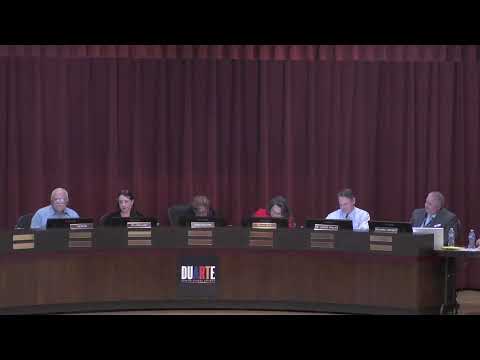
The Duarte Unified School District Board on Oct. 9 approved a resolution (No. 082526) certifying the final environmental impact report for the former Andres Duarte School site and authorizing a joint-occupancy development agreement and 99-year ground lease with Crestfield Townhomes LLC, passing 4–1.
Board members and district staff described a multi-year procurement and public-review process. Acting Superintendent Rick Crosby introduced outside counsel and development representatives who reviewed the project scope, community outreach, and financial terms. Counsel identified the actions before the board as certification of the EIR, adoption of CEQA findings and a Mitigation Monitoring and Reporting Program (MMRP), and approval of the development and ground-lease documents.
Developer representatives and their advisors told the board the project would convert roughly half the closed campus (about 6.5 acres) to residential townhomes and retain and upgrade about 6.32 acres as park and open space under district ownership. Robert Montano of Crestfield Development described revisions made after community feedback — moving park parking to Central Avenue, improving perimeter separation from adjacent homes, increasing park features and fixtures and doubling the originally estimated park budget to roughly $4 million. Jeff Atkinson of Jones Lang LaSalle summarized the financial analysis presented to the board: an annual base ground rent of $450,000 (paid in 12 monthly installments) escalating 2.5% per year, an upfront payment to the district of $1,000,000 (with $200,000 already received in 2024 and $800,000 payable at escrow), and a developer commitment to spend approximately $4,000,000 on park improvements.
The developer and advisors said the residential component would be larger-family townhomes — three- and four-bedroom units with an average unit size around 1,400 square feet — with 28 below-market affordable units (16% of the 169-unit project). Project documents presented to the board called for a 99-year ground lease and various district protections in the lease including insurance, indemnity and default remedies; the district retains audit rights and may terminate the lease for enumerated defaults (nonpayment of rent, material violations, bankruptcy, abandonment).
Public comment at the meeting was extensive and sharply divided. Dozens of speakers urged two opposing outcomes: some parents, community leaders and public-safety advocates urged approval, saying the project generates revenue for the district, upgrades park space and builds large-family units not otherwise available in Duarte; other residents and teachers objected, arguing the process was incomplete, that neighbors were not adequately consulted and that the project would cause traffic, parking and recreational impacts and permanently remove school property from public-school use. Speakers raised legal questions including references to the Naylor Act, the California Voting Rights Act and alleged shortfalls in outreach; some threatened litigation if the district proceeded without additional public review.
Board discussion included questions about affordable-unit rules, park-tree replacement, unit maintenance and the project’s potential to influence enrollment. Board member James Finley, who had served throughout the asset-committee and procurement process, said he had agonized over the decision but ultimately voted in favor to provide the district with a revenue stream that could be used for general-fund purposes, including compensation and programming. Board member Antonio Reyes voted no and expressed concern about losing the school property, transparency of outreach and the long-term trade-off between capital and operating needs.
The board approved Resolution 082526 by roll call: Board member Diaz — yes; President James Finley — yes; Board member Holguin — yes; Board member Hasso — yes; Board member Reyes — no. After the vote the board directed staff to continue communications with the developer, finalize closing conditions and proceed with the lease and monitoring program required by CEQA.
Key numbers and contract terms presented to the board: - Annual base ground rent: $450,000 with 2.5% annual escalator - Upfront payment to district: $1,000,000 (of which $200,000 already received; $800,000 at escrow) - Developer-funded park improvements: roughly $4,000,000 - Residential component: approximately 6.5 acres, 169 units total, 28 units (16%) affordable - Park/open-space to remain under district control: approximately 6.32 acres - Lease term: 99 years
The district’s counsel and the developer’s documents list multiple protections for the district (insurance, indemnity, maintenance obligations, audit rights and termination rights for default). Several speakers asked the board to require additional guarantees — for example, penalties if the developer failed to deliver student-creating households — but the approved documents do not include guaranteed student-yield covenants. The district said the lease proceeds would be unrestricted general-fund revenue and could be used for operating needs if the board so chooses.