Get AI Briefings, Transcripts & Alerts on Local & National Government Meetings — Forever.
Salem council refers draft 40R zoning for Margin Street: would allow shelter expansion, 75% deeply affordable units
Loading...
Summary
Mayor Dominic Pangalo urged the council and planning board to approve a draft Smart Growth Overlay (40R) subdistrict for Margin Street that would allow LifeBridge to replace its shelter and HarborLight to build supportive housing, including a proposed 75% of units at or below 60% AMI.
Mayor Dominic Pangalo urged the council and planning board to approve a draft Smart Growth Overlay (40R) subdistrict for Margin Street that would allow LifeBridge to replace its outdated shelter with a 70-bed, noncongregate facility and allow HarborLight-linked housing on adjacent parcels with a substantial amount of deeply affordable units.
"Homelessness is a crisis not just in Salem but across our region," Mayor Dominic Pangalo said, citing the Greater Boston Continuum of Care’s figure that the number of people experiencing homelessness "rose by 67% between 2023 and 2024." He and city housing staff said the proposal is intended to create supportive housing and reduce time people spend unsheltered.
The draft Margin Street Smart Growth Overlay Subdistrict (Margin Street SGO) would cover roughly 0.68 acres including 54–56 Margin Street and nearby Endicott and High Street parcels and change dimensional and use standards to allow higher residential density and explicit supportive-housing uses. Planning staff told the joint public hearing that the zoning sets a maximum of 115 units per acre, a 55-foot/4-story height limit, 75% lot coverage, and a minimum 25% open-space requirement. Under those metrics, staff said, the site could hold up to 78 units as of right; after subtracting 22 existing residential units within the subdistrict boundary, the zoning could enable up to 56 net new units.
The subdistrict text would make "supportive housing" a by-right use and set affordability terms well above the city’s baseline: 75% of residential units would be deed-restricted at or below 60% of area median income (AMI). Planning staff said that exceeds the umbrella 40R ordinance adopted earlier this year (which follows the state expectation of 20% at or below 80% AMI) and Salem’s inclusionary housing ordinance (10% at or below 60% AMI).
City staff and the project team described parallel components: LifeBridge would convert from a congregate 50-bed model to a 70-bed, noncongregate shelter and HarborLight would develop the permanent supportive housing portion. Andrew D'Frenza (HarborLight) and a LifeBridge representative identified as Jason said the residential units would be separately managed and occupied under leases; tenants could access but would not be compelled to participate in shelter-based services. "You don't have to go, for example, to a group session on such and such on Tuesday," Andrew D'Frenza said, describing how tenancy and services are governed differently between the housing and shelter components.
Planning staff also described procedural and legal context: the Margin Street SGO was submitted to the Executive Office of Housing and Livable Communities (EOHLC) and received a letter of conditional eligibility in June 2025. The city’s 40R process requires public hearings and a Planning Board recommendation before City Council first- and second-passage votes; staff noted the council has 90 days from the joint hearing to act (running to Jan. 13, 2026, as presented).
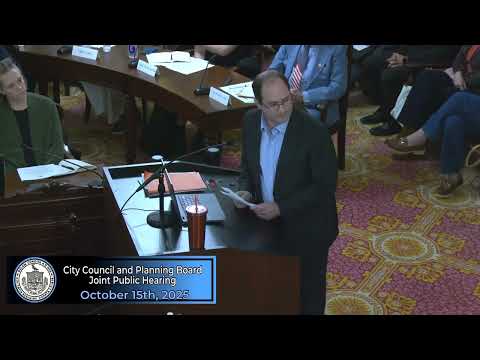
At the public hearing held before a packed chamber, testimony ran strongly both for and against. Supporters — including local service providers, housing navigators and Salem residents — said the proposal would expand services, create deeply affordable units, and help people move from shelter to permanent housing. Opponents — including nearby homeowners and neighborhood advocates — raised concerns about neighborhood impacts, traffic and public safety, the scale of the project, and whether LifeBridge and HarborLight staff levels and operating plans are adequate. Several speakers asked for legally binding commitments on local preference for Salem residents, staffing levels, and preservation of historic features such as the St. Mary’s building and Christopher Columbus Club memorials.
City staff and project representatives addressed several technical issues raised by neighbors: the site is not within the Salem Redevelopment Authority boundary, projects in the SGO would still require separate historic-commission and site-plan reviews, and the proposed design standards are intended to be objective to meet state 40R requirements. Planning staff also noted that projects requiring historic-commission review or federal/state subsidy would trigger additional environmental and archaeological review protocols.
On process questions, Planning Department staff said parking minimums were removed from the umbrella 40R ordinance and that the subdistrict proposes parking maximums (for example, 1.75 spaces per dwelling unit for multifamily/supportive housing and 1 space per 1,000 square feet for other uses). Staff estimated state 40R incentive payments of a $75,000 base payment plus $3,000 per net new unit that receives a building permit, a sum staff said could yield approximately $68,000 under the current density scenario.
Councilor Marcello moved to refer the zoning petition to the Planning Board for a formal recommendation; the City Council approved the referral by voice vote. The recommendation from the Planning Board will return to the council for first and second passage votes; if adopted locally, the zoning would then be returned to the state for final sign-off under Chapter 40R before site-level permitting and any construction.
Opponents asked the council to pause and require additional guarantees on services, funding and neighborhood mitigation; supporters asked the council to keep the zoning on a fast track to expand shelter and create permanent, deed-restricted housing. The Planning Board will now consider written and oral testimony and return a recommendation to the City Council.
For next steps: the Planning Board review and its public hearing are the immediately scheduled actions; City Council would then consider first passage and, if approved, second passage within the statutory timeline and remit a final version to EOHLC for state review under Chapter 40R.