Get Full Government Meeting Transcripts, Videos, & Alerts Forever!
Get email alerts on the Public Finance topic
No spam. Unsubscribe anytime.
Gadsden County adopts 9-mill tax rate and $70.09 million budget amid public calls for rollback
Summary
The Gadsden County Board of County Commissioners on Sept. 30 adopted a final millage rate of 9 mills and a $70,092,617 fiscal year 2025–26 countywide budget after public comment pressed the board to adopt the lower rollback rate of 8.6383 mills.
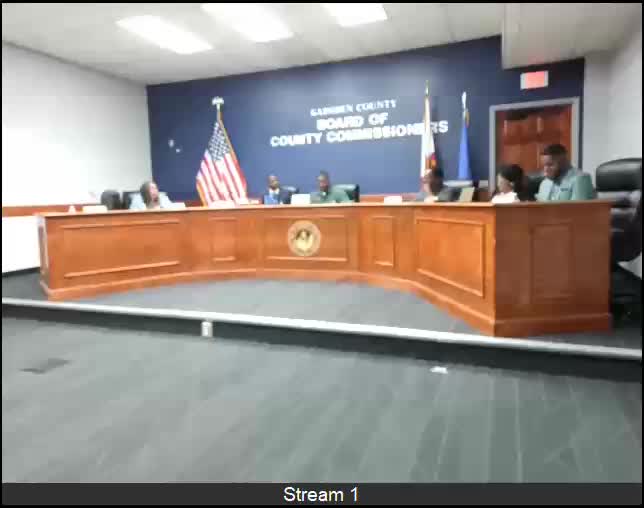
The Gadsden County Board of County Commissioners on Sept. 30 adopted a final millage rate of 9 mills and a $70,092,617 countywide budget for fiscal year 2025–26 after a public hearing in Quincy that drew multiple residents urging the board to adopt the lower rollback rate of 8.6383 mills.
The adoption came after more than an hour of public comment and discussion among commissioners and staff about department needs, rising costs for public safety and public works, and whether the county could absorb the revenue gap without raising the millage. Commissioner Eric Kenton signed the budget resolution presented to the board.
Why it matters: The millage rate and budget determine county property tax bills and how roughly $70.1 million in county revenue will be allocated across law enforcement, EMS, public works, human services and other county functions. Several residents and county employees told commissioners higher taxes are driving hardship for seniors and homeowners and urged either adoption of the rollback rate or targeted cuts in the budget.
Commission action and legal context The board held the required TRIM (Truth in Millage) hearings and reviewed notices certified by the county property appraiser before taking action. The board adopted a final countywide millage of 9 mills — described in staff materials as 4.19% above the rollback rate of 8.6383 mills — and approved a final county budget of $70,092,617.
Votes at a glance - Final millage rate: Motion to adopt 9 mills — outcome: approved (motion and second recorded; vote tally not specified in the hearing transcript) - Final fiscal year 2025–26 countywide budget: Motion to adopt $70,092,617 — outcome: approved (motion and second recorded; vote tally not specified in the hearing transcript)
What commissioners and staff said Finance staff explained the millage history and the relationship between assessed values and taxes, noting that Gadsden County’s millage has been at 9 mills for several recent years and that the proposed 9 mills would generate additional revenue compared with the rollback rate. In the hearing, a finance official summarized the procedural requirements under Florida Statutes (including sections 200.065 and 129.03) and emphasized that millage must be adopted before final budget line-item discussion.
Public comment: concerns about taxes, services and public safety Multiple residents urged the board to adopt the rollback rate. David Waslowski, a Quincy resident, told the commission, “I would like to encourage you guys to reconsider,” and said rising property taxes were harming homeowners and local businesses. Clarence Jackson, another resident, said Gadsden County already had among the highest millage rates in the surrounding counties and urged a rollback: “We already have the highest millage rate in our 4-county area,” Jackson said.
Speakers repeatedly raised impacts on seniors and fixed-income households. Neil Wade said recent tax increases were “coming from the owners and the citizens of Gadsden County” and urged commissioners to adopt the rollback to protect vulnerable residents.
Local public-safety employees and advocates urged the board to keep or increase funding for law enforcement and EMS. Captain Angie Holmes of the Gadsden County Sheriff’s Office said the office needs funding to support recruitment, retention and the full range of sheriff’s office services. Janet/Janice Tice, who identified herself as evidence unit staff, described the operational costs of evidence processing and said, “It takes money and everything is going up.” Sam (Sagan Morales), a records-and-warrants employee, asked the board to support first responders and staff.
Budget priorities and contested items Commissioners and staff discussed several budget pressures cited during the hearing: an estimated $1,100,000 additional request for EMS, additional funding for the sheriff’s office (discussed during the session as roughly $1,500,000 for specific requests), public works equipment and maintenance needs, and capital concerns such as full-time fire coverage and facility conditions. Public commenters also urged scrutiny of large equipment purchases and contractors; one resident with mechanical experience offered to volunteer to review public-works equipment repairs.
Several commissioners noted that most departmental budgets (76 of 96 expenditure budgets in staff materials) were level-funded from the prior year, and staff warned that level funding does not absorb rising costs such as health insurance, retirement contributions and utilities. The board agreed to hold follow-up meetings with constitutional officers and department heads to review line items and to seek potential savings and cross-agency coordination.
Process and next steps Staff and the county attorney reminded the board that TRIM hearing procedures require adoption of the millage rate before detailed budget amendments; commissioners said they would convene follow-up meetings with the sheriff, EMS, fire and other agencies to identify options for savings or adjustments and to review budget line items once the millage decision was recorded.
Ending With the millage and budget adopted, the county will implement the fiscal year 2025–26 budget as the baseline for operations; commissioners said they planned additional meetings and possible budget amendments if departments identify critical needs or savings. Several residents told the board they intend to remain engaged in coming weeks as the county refines spending priorities.