Get Full Government Meeting Transcripts, Videos, & Alerts Forever!
Advisory committee backs Innovation Partnership Fund framework, urges emphasis on community-run organizations
Summary
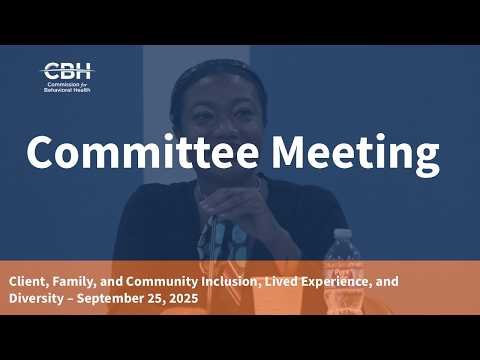
The Client, Family and Community Inclusion committee voted Sept. 25 to recommend that the full Mental Health Services Oversight and Accountability Commission adopt version 3 of the Innovation Partnership Fund framework, while urging that the state's forthcoming RFP explicitly emphasize community-run organizations and community-defined practices.
The Client, Family and Community Inclusion, Lived Experience and Diversity Advisory Committee voted Sept. 25 to recommend that the full Mental Health Services Oversight and Accountability Commission adopt version 3 of the Innovation Partnership Fund framework, while adding a committee request that the fund’s forthcoming request-for-proposals emphasize and incentivize community-run organizations and community-defined practices.
The Innovation Partnership Fund, or IPF, is a Prop 1 program that the commission will administer beginning July 1, 2026. Commissioner Gary Tsai, chair of the commission’s Program Advisory Committee, described the fund during the committee’s presentation as “a $20,000,000 per year for five years” effort to invest in new or adapted approaches to California’s behavioral health system. Melissa Martin Mollard, deputy director for research, evaluation and programs, told the committee staff are preparing an RFP outline for January 2026 and aiming to make grant awards so projects can begin July 1, 2026.
The committee’s endorsement was symbolic — advisory committees can only advise the full 27-member commission — but members and public commenters pressed staff to ensure the RFP 1) protects funding paths for smaller community-based and peer-run organizations, 2) builds robust evaluation and technical assistance support into awards, and 3) clarifies how the statute’s priority populations will be interpreted.
Why it matters: Prop 1 modernizes prior county-directed MHSA innovation funding by placing $20 million a year under state administration (IPF) to target populations the statute identifies as having the highest behavioral health needs. Committee members and community advocates repeatedly warned that without explicit scoring or capacity-building measures, well-resourced applicants could outcompete smaller culturally rooted providers that serve people most affected by behavioral health disparities.
What the committee heard
At the Sept. 25 meeting, Tsai and Melissa Martin Mollard presented the IPF framework, summarized stakeholder…
Already have an account? Log in
Subscribe to keep reading
Unlock the rest of this article — and every article on Citizen Portal.
- Unlimited articles
- AI-powered breakdowns of topics, speakers, decisions, and budgets
- Instant alerts when your location has a new meeting
- Follow topics and more locations
- 1,000 AI Insights / month, plus AI Chat