Get Full Government Meeting Transcripts, Videos, & Alerts Forever!
Get email alerts on the Council Compensation topic
No spam. Unsubscribe anytime.
Bothell leaders urge higher council pay to widen access; commission sets options and timeline
Summary
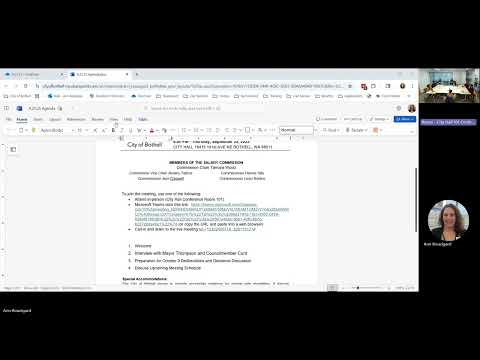
At a Salary Commission meeting, Bothell elected officials and residents argued that current pay and hidden costs deter a diverse pool of candidates. Staff offered benchmarking data and the commission agreed to discuss three compensation options and to hold a public hearing in October.
Bothell officials, current council members and residents told the city's Salary Commission on Wednesday that council compensation should be raised to reduce financial barriers to serving and to broaden who can run for office.
Speakers at the commission meeting described the work as a de facto half-time executive job, noted costs that go beyond time spent in meetings, and urged a simple, well‑paid package that includes access to ordinary employer benefits. City staff told the commission that one benchmark Mayor Mason Thompson suggested'half the city's median household income'would equal about $66,000 for a half‑time position.
Why it matters: Commissioners are preparing a recommendation the City Council will see before a public hearing. Changes in compensation affect who can afford to run for and hold office, the commission heard, and the commission must balance fairness, precedent and the city's ordinance and procedure for making adjustments.
Discussion highlights
- Barriers to serving: Multiple speakers described uncompensated costs of public office including lost wages, campaign time, personal and family stress, online harassment and other nonfinancial burdens that can discourage working‑age people from running. One long-form account described elected service as "a half‑time job" that often requires other family members to absorb unpaid labor at home; the speaker said those unseen costs mean many potential candidates cannot afford to serve.
- Benchmarks and approaches: Participants proposed several ways to set pay. Staff summarized an option Mayor Mason Thompson raised: using half the city's median household income (staff calculated about $66,000 for a half‑time role). Commissioners and staff also discussed an hourly approach (multiply a typical weekly hour estimate by a chosen hourly rate) and a packaged salary plus benefits approach. The commission noted that the survey responses from potential candidates showed a modal work estimate of about 20 hours per week.
- Benefits and simplicity: Several participants recommended keeping compensation simple and broadly available rather than means‑testing or providing narrowly targeted stipends. One attendee argued that a straightforward half‑time salary plus access to the city's nonrepresented benefits package (health coverage, deferred compensation participation) would be appropriate.
- Equity and access: Commissioners were asked to focus on measures that would increase demographic and economic representation on the council. Staff reminded the commission that Public Disclosure Commission filings and publicly available census/demographic snapshots can be used to compare current officeholders to the community.
Timing, next steps and process
City staff told the commission it will prepare a consolidated packet for the next meeting that includes the prior year's salary commission data, updated benchmarking, a short summary of health‑benefit options, and demographic comparisons (including Public Disclosure Commission data) if the commission wants them. A city staff member reminded commissioners that "before you implement any change, you have to have a public hearing," and explained the schedule options the group could take to meet the ordinance timeline.
At the meeting commissioners agreed to examine three options at their next work session: (1) status quo, (2) a medium increase based on a higher hourly/half‑time benchmark, and (3) a higher option approaching a half of median household income or equivalent executive half‑time benchmark. The commission tentatively scheduled a decision meeting and a public hearing on the dates discussed (next meeting on Oct. 9 and public hearing on Oct. 23) and asked staff to show how each option would be calculated and justified in packet materials.
What was not decided
No formal vote to adopt a pay change occurred at this meeting. Commissioners discussed whether to attach automatic adjustments such as a cost‑of‑living increase (COLA) but did not adopt any such mechanism; staff said the commission may include that as a question to consider. Commissioners also talked about possible phased implementations (multi‑year steps) but noted limitations in the ordinance and that any staged approach would need to conform with the city's procedural rules.
Looking ahead
The commission asked staff to prepare three concrete options with underlying assumptions (hours, hourly rate or median‑income calculation, benefits package) for the next meeting packet so commissioners can deliberate toward a final recommendation and a public hearing. The commission will present a recommendation to the City Council after the required public hearing, per city procedure.